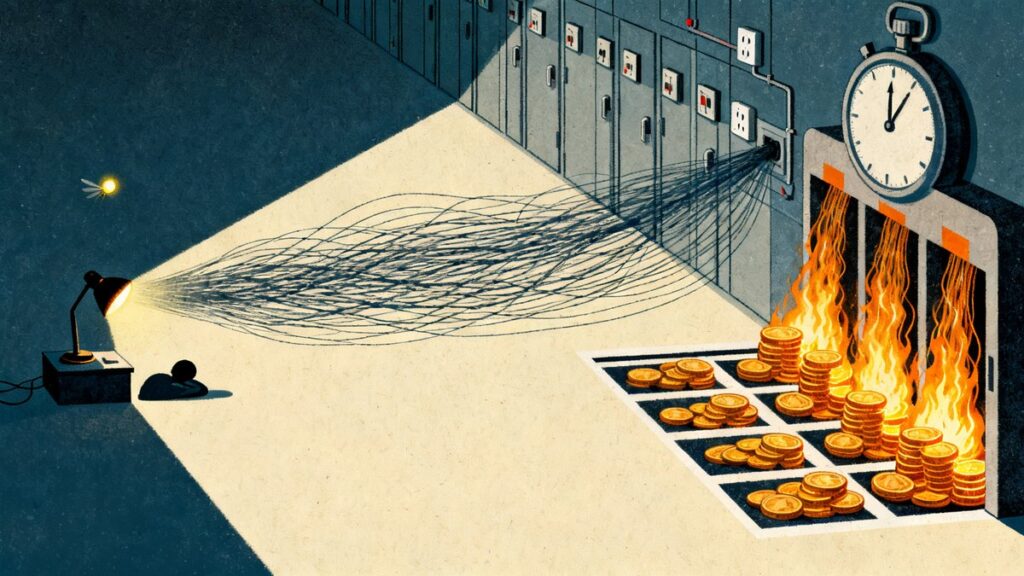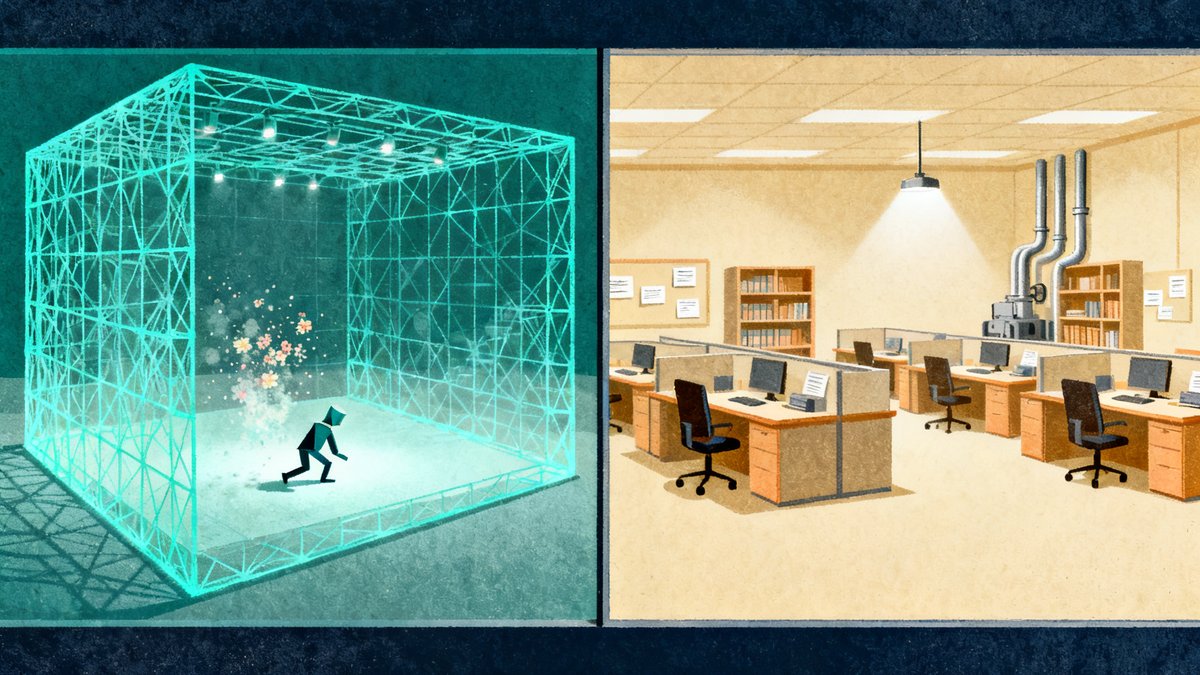
A programmable world model is, at bottom, a rehearsal room. The agent acts, a learned simulation answers, nothing real breaks.
April 2026 gave the idea its formal definition. An arXiv paper titled “Agentic World Modeling” describes a world model as a system that “learns the state-transition dynamics of an environment: given a current state and an action, it predicts the resulting next state” (arxiv.org). Strip the jargon and you have a learned simulator answering one question. What happens if the agent does X. Before the agent touches anything real. Programmable means you set the environment, the actions. And the rules, then let the agent train inside the copy until it stops failing.
Failures move somewhere cheap.
That’s the entire pitch. And for anyone shipping LLM automations it’s the most practical direction agent development has taken in years.
What Is a Programmable World Model?
Contested term. Which is exactly why vendor claims slide around it.
A r/MachineLearning thread flags the split: “world model” gets used both for static, abstract knowledge of a physical world and for the shifting state of a current environment as the agent perceives it. Two different products wearing one label.
Builders want the second one. You’re not buying a machine that understands physics. You’re building a model of one environment. Your CRM, your inbox, an order pipeline. Narrow world, sharper predictions, easier to catch when they drift.
That’s also the honest pitch. A model that predicts the next state of your ticketing system under three specific actions is testable.
A model that “understands the world” is a keynote slide.
Programmable World Models vs. Prompt-Conditioned Agents
Here’s the part that sounds like science fiction and is actually eight years old.
The World Models project. Published 2018, still referenced throughout 2026. Trained a large network unsupervised to learn “a compressed spatial and temporal representation of the environment,” then trained a small policy on the features that model produced (worldmodels.github.io). The mechanics run three steps:
– A VAE compresses raw observations into a latent representation.
– A dynamics model learns how that latent space evolves.
– An evolutionary strategy finds a small linear policy on top of it.
The result, in the authors’ own words: they could “train our agent entirely inside of its own dream environment generated by its world model. And transfer this policy back into the actual environment.”
Trained in dream. Shipped in reality.
Most model-based RL, as the Reddit discussion points out, learns a model of the environment but still trains on the real thing. World Models flips the order. And because the world model absorbs the complexity, the policy controller can be, per the project’s documentation, “very compact and simple.”
Current agent stack has this backwards. Giant model in the decision seat, prompt as its entire world. The 2018 architecture says do the opposite: large model holds the world, decider stays small, cheap, inspectable.
I read the paper on a Tuesday night between two client deploys and had to put it down for a minute.
Somebody had already named the thing I’d been hand-rolling for a year.
The L1-to-L3 Ladder: Predict, Simulate, Evolve
The April 2026 paper.
ArXiv 2604.22748, identifier included for anyone keeping receipts.
Does something more useful than define the term. It ranks capability on three levels:
– L1 Predictor — “learns one-step local transition operators.”
– L2 Simulator — “composes them into multi-step, action-conditioned rollouts that respect domain laws.”
– L3 Evolver — “autonomously revises its own model when predictions fail against new evidence” (arxiv.org).
Read that as a buyer’s checklist.
Most of what gets marketed as a world model today sits at L1 or L2. It predicts, maybe simulates. It does not revise itself. The “learns and adapts” claim belongs to L3 alone, and that rung holds both the value and the risk. A model that updates itself when reality contradicts it is genuinely adaptive.
The same model can update itself wrongly, then simulate with total confidence from a broken map of your environment.
Honest admission: first pass through the taxonomy, I assumed L2 covered adaptation. It doesn’t. Caught it on the second read and felt dumb.
So put two questions to any vendor:
– Which rung of that ladder is the product actually on?
– What exactly happens when a prediction fails?
A shrug means you’re buying L2 hardware with L3 marketing.
Would you let an agent rewrite its own beliefs about your CRM with nobody watching?
That’s the L3 question, compressed to one line.
1,000 Synthetic Environments, a Million Fake Users
The 2026 papers industrialize the dream. February 2026, arXiv again: “Agent World Model: Infinity Synthetic Environments for Agentic Reinforcement Learning” proposes a “fully synthetic environment generation pipeline” that scales to 1,000 environments covering everyday scenarios, each with rich toolsets and high-quality observations (arxiv.org).
Instead of scraping fixed datasets, agents learn by interacting with these generated worlds. And the paper demonstrates large-scale reinforcement learning for multi-turn tool-use agents.
Same shape outside the lab.
Project OASIS is described by its team as an “open-source simulated social environment with millions of large language model agents” built to mimic behavior on platforms like Twitter and Reddit, where agents “create posts, share content, follow other users. And engage in discussions” (camel-ai.org). A related page calls it a “scalable, open-source social media simulator,” pairing LLMs with rule-based agents to mimic up to one million users.
Look past the scale and see the shape. It’s a test fixture, grown up. You generate the world, generate the users. And let an agent fail against all of it before it ever touches a live account.
Every operator who has hand-built a fake customer record to smoke-test a workflow has already done the two-minute version.
Haven’t run OASIS myself. The one-million-user figure comes off their own project page and I’m taking it on trust.
How to Build a Programmable World Model for One Automation
Client rule, held for years: no agent touches a production system until it survives a copy of that system. Programmable world models are that rule, formalized.
The research is catching up to the practice.
Three takeaways for operators:
– Separate the simulator from the policy. A cheap model of your environment plus a small decision loop beats one giant model improvising inside a prompt. And the small loop is the part you can actually audit.
– Treat synthetic worlds as the staging environment you stop apologizing for. Breakage there costs nothing.
– Notice the gap. The public material is nearly all surveys, rankings, and theory; almost nobody writes the practice layer for small teams. First operator to work this out gets an edge that won’t last.
Start small and start now. Pick one automation you run and write down every state it can be in, every action your agent can take. And what the next state should be after each one.
Have you ever actually written that out?
Neither had I, until a client asked and it turned into forty minutes of scribbling.
That document is a world model spec.
L1, by hand.
Most operators already carry it in their heads and never put it on paper.
Programmable World Model FAQ
What is a programmable world model?
A learned simulator of one specific environment that you define.
States, actions, rules. So an agent can train and fail inside the copy before touching production.
Formally: a system that “learns the state-transition dynamics of an environment: given a current state and an action, it predicts the resulting next state.”
What’s the difference between L1, L2, and L3?
L1 predicts one step ahead.
L2 composes those steps into multi-step, action-conditioned rollouts.
L3 revises its own model when predictions fail against new evidence. Only L3 genuinely “learns and adapts.”
Why not just give the agent a better prompt?
A prompt conditions behavior. It doesn’t predict the next state of your environment. The 2018 World Models result argues the opposite architecture: large model holds the world, small policy decides.
How do I start with one automation?
Write the spec by hand. Every state, every action, every resulting next state. That’s an L1 world model. Run the agent against it before production and watch where the predictions break.
Are self-updating agents safe to run unattended?
That’s the open L3 question. A model that revises itself when predictions fail is adaptive. And can too revise itself wrongly, then simulate confidently from a broken picture. Get the vendor’s failure story before you buy.
Sources
– Agentic World Modeling (arXiv, April 2026)
– World Models project
– Agent World Model: Infinity Synthetic Environments for Agentic Reinforcement Learning (arXiv, February 2026)
– Project OASIS — CAMEL-AI
– r/MachineLearning discussion of competing “world model” definitions