
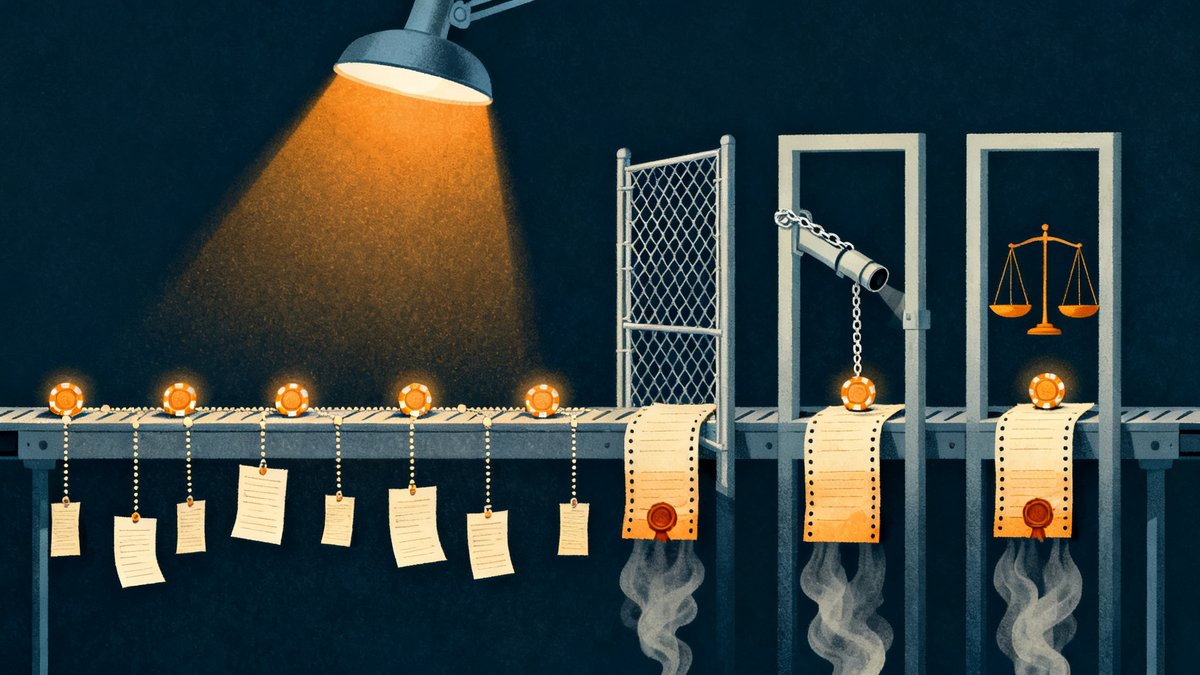
C²-Cite raised citation quality by an average of 5.8% and response correctness by 17.4% on the ALCE benchmark. And the gap between those two numbers is the story. LLM citation and source tracking is the discipline of proving that every claim in a model’s output maps to a source that exists, matches the topic. And actually supports the sentence it is attached to. A 2026 evaluation framework called “Cited but Not Verified” scores inline citations on exactly those grounds, across three dimensions: Link Works, Relevant Content, and Fact Check (arXiv).
Until you run checks like those, every [1] in your agent’s output is decoration.
A Citation Marker Is a Token the Model Chose to Emit
The researchers behind “How Do LLMs Cite?” (arXiv) start where every RAG builder starts: retrieval-augmented generation grounds outputs in external documents, “often using inline citations for verifiability.” Then they break the comfort with one definition. “Citation faithfulness” means “a citation occurring only when the model’s internal computation genuinely used the cited document to construct the answer.” Define it that way and the failure mode becomes visible: unfaithful citations, markers printed for documents the model never actually used.
The same paper reports that citation generation is not handled by one specialized module. It is carried by a distributed “attributional ensemble” of attention heads and MLPs. Operator translation: no lookup function fires before [3] gets printed. Because the marker comes out of the same machinery that writes the prose.
My agency treats every citation in an agent deliverable as an unverified claim, the same way an editor treats a footnote before print.
One distinction matters here, given that vendors blur it.
Retrieval citations point at documents your agent was handed at query time. Training-data attribution is a different problem: the arXiv survey “Source Attribution for Big Language Model-Generated Data” defines it as mapping LLM-generated text back to the source responsible for influencing it. And proposes watermarking as the fix, with the model generating synthetic texts carrying embedded information about their source, examined later to identify the data provider (arXiv). That research matters for copyright fights and data licensing. It does nothing for the report your agent wrote this morning.
The Training Fix: Quote First, Then Write
Three research efforts attack citation quality at the training layer.
And they converge on one idea: make the model earn each marker.
A 2024 arXiv paper, “Training Language Models to Generate Text with Citations via Fine-grained Rewards,” replaces a single correctness score with fine-grained rewards, teaching models to produce citations that are both supportive and relevant while keeping answers correct (arXiv). FRONT, from 2024 ACL Findings, flips the generation order: fine-grained supporting quotes are grounded first, then guide generation (ACL Anthology). C²-Cite, published in 2025, makes markers behave as “active knowledge pointers” that stay aware of surrounding context, encoding retrieved document contexts into citation symbol representations and decoding marker numbers through a citation router. That is where the 5.8% citation-quality gain and the 17.4% correctness gain on ALCE come from (arXiv).
The C²-Cite authors name the root cause plainly: models suffer “insufficient awareness of the context information surrounding citation markers,” producing “disjointed references and poor integration of retrieved knowledge.” Read that twice. The dominant failure is the citation not matching the sentence around it.
You will not fine-tune a model this quarter, and you do not need to. Steal FRONT’s ordering in your pipeline instead: force the agent to pull a verbatim supporting quote from a retrieved chunk before it writes any claim, then attach the marker to that quote. Quote-first generation is free, and it makes unfaithful citations surface at generation time rather than at client review.
Check Every Citation on Three Axes Before It Ships
“Cited but Not Verified” is the most immediately usable piece of this research as it works at build time. The framework introduces a reproducible AST parser that extracts and evaluates inline citations from LLM-generated Markdown reports at scale (arXiv).
Each citation is then scored on three dimensions: Link Works verifies URL accessibility, Relevant Content measures topical alignment with the claim. And Fact Check validates factual accuracy against the cited content.
Each axis catches a other lie.
Link Works catches fabricated references, the ones pointing at pages that never existed. Relevant Content catches the subtler dodge, a real page that shares keywords but never supported the claim. Fact Check catches the worst case, a real and relevant source that does not say what your agent said it says. If your agents emit Markdown.
And most do, deterministic parsing means you never need a second model grading the first model’s homework.
What This Means If You Run a Small Team
The uncomfortable read of this research: citation quality lags answer quality even when researchers train specifically for citations. Assume your agent’s citations are its weakest output and budget accordingly.
– Treat every citation marker as a claim to verify, never as evidence in itself.
– Reorder your pipeline so verbatim quotes come from retrieved sources before any claim is written.
– Put the three checks, link resolution, topical alignment, and factual support, into your build process so no report ships with an unchecked marker.
– Track citation failures like incidents, since a confidently cited wrong source is worse than an uncited one.
None of this requires a research lab. Deterministic citation extraction plus three checks is a weekend build for anyone already running agents in production. The cost asymmetry is the real argument: an uncited claim invites skepticism.
But a polished citation to a source that does not support the claim transfers your credibility to a lie the client will eventually find.
Small teams do not carry trust reserves big enough to survive that.
Citations You Can Defend
The research is converging on one standard: a citation is only as good as the verification behind it. And verification has to be automated to survive scale.
The papers above define the pieces, faithfulness at generation, alignment at training, three-axis checks at review. Your job as an operator is to enforce that standard in the pipeline you actually run. If your agents ship reports with unchecked citations, fix that before adding the next feature.
Mediascout builds and audits citation verification loops for small teams running agents in production; if you want yours stress-tested, get in touch and we will trace where every claim actually came from.


Deterministic parsing can extract markers, but it cannot establish factual support. Saying “you never need a second model grading the first model’s homework” skips the harder semantic check: whether the cited passage actually supports the claim.
Calling this a weekend build seems optimistic. “Deterministic citation extraction plus three checks” bundles finding markers with judging factual support, but parsing a report alone cannot establish whether a source supports its claims.
A Markdown parser can extract markers, but it cannot establish factual support. Saying “you never need a second model grading the first model’s homework” skips how the Fact Check step handles a relevant source that contradicts the claim.