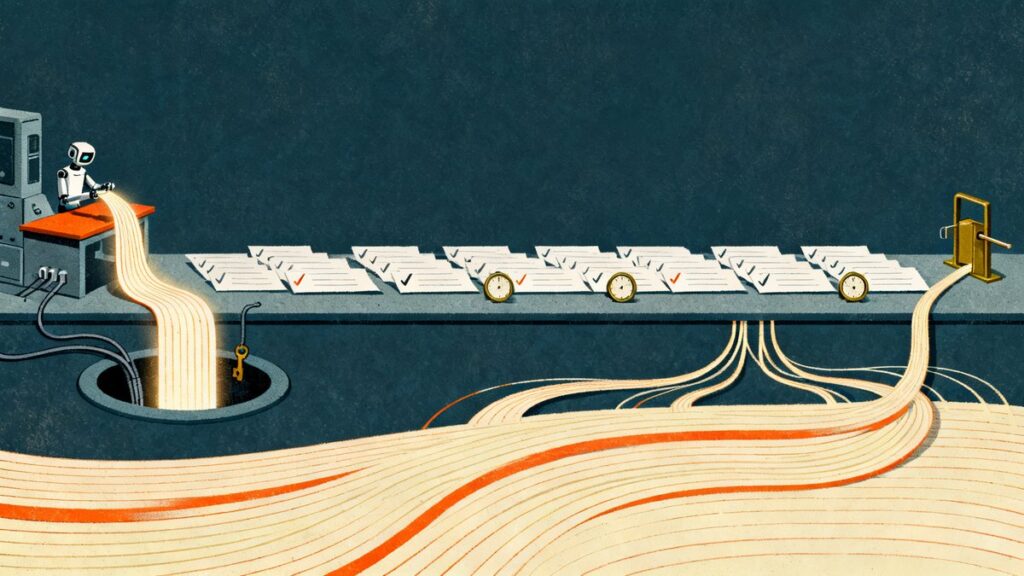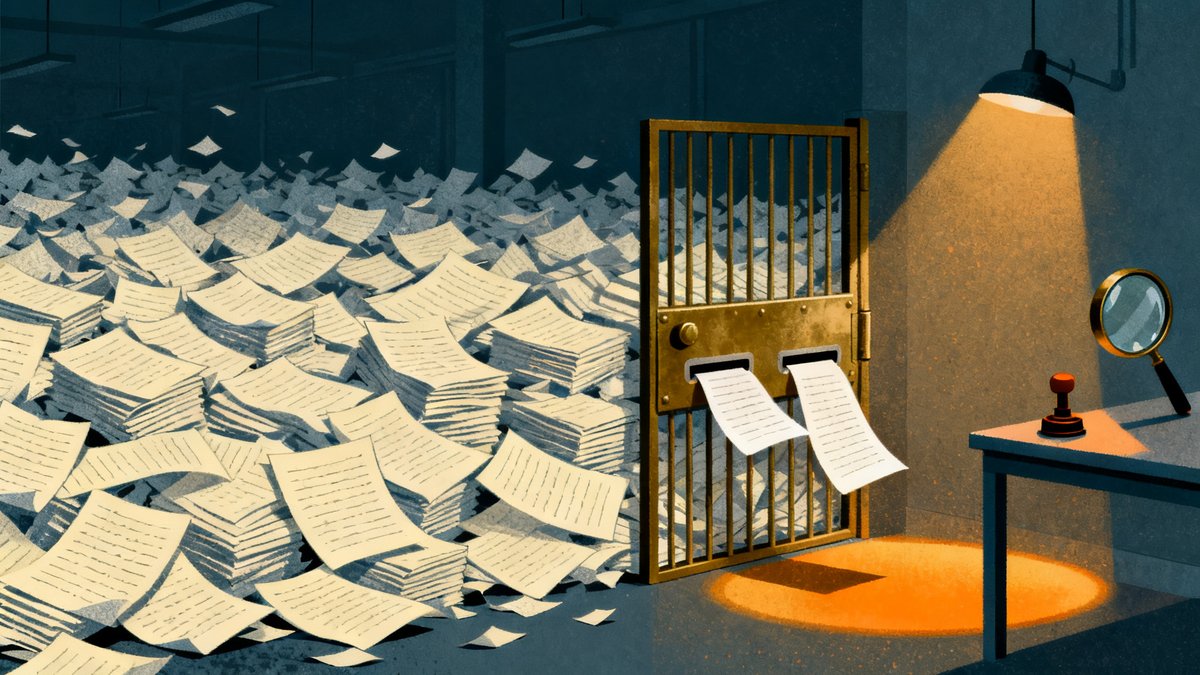
arXiv now caps every submitter at two papers per calendar month.
The new submission limit took effect October 1, 2026, covers all categories. And applies whether a paper was written entirely by humans or produced with AI tools. Each submitter is also limited to three active submissions at any given time. And rejections burn your quota just like acceptances. So two rejected submissions in October means waiting until November to try again. The cap landed after September 2026 submissions reached 40,363. And arXiv describes the whole thing as a “stopgap” while it rebuilds moderation for the volume of AI-assisted manuscripts now showing up at the door (arXiv blog).
I don’t run a research lab.
I build and ship AI automation, mostly content pipelines. And this story matters to me anyway. arXiv just hit the wall where generation is nearly free and review is not. And what it did next is a preview of what every publishing platform you depend on will do. Read the mechanics, not the headlines.
What the New arXiv Submission Limit Actually Says
The policy is short and blunt.
Every rule that matters, straight from the official announcement:
– Two submissions per calendar month, per submitter, across all arXiv categories, effective October 1, 2026.
– Three active submissions max at any one time. An active paper is one that has been submitted, is under consideration and review, but not yet published, an arXiv spokesperson told The Register.
– Rejections count. Submit two papers in a month, accepted or rejected, and you wait for the next month.
– The limit follows the submit button. A paper with several co-authors counts only against the person who submitted it, not the co-authors.
– No AI carve-out. The Register reports the hard limit applies regardless of whether papers were produced solely by humans or with help from AI tools.
One detail that keeps getting lost: the three-active cap is old.
The Register notes it has been in place since 2024. The monthly two-cap is the new part. And it is explicitly temporary. arXiv calls it a stopgap while it figures out best practices for authors using increasingly advanced AI tools and improves its moderation procedures.
The Volume That Forced It
The forcing function is scale. A paper published on arXiv analyzing the change puts September 2026 submissions at 40,363, the month right before the cap arrived. The Register framed the cause plainly: arXiv is seeing so many low-quality submissions, with AI tools helping drive the surge, that it imposed the hard limit.
arXiv’s own language is worth reading slowly. “With AI tools becoming more advanced and accessible to authors, the ‘practical limit’ of how many papers can be submitted is now up for debate.” Translation: generation speed outran every informal norm the archive ran on. The stated goals are to “fairly distribute the incredibly valuable work of our volunteer moderators” and to encourage authors to “curate and submit only their best work.”
I’ll give arXiv credit most platforms never earn: it said the quiet part out loud.
This is not a strategy, it’s a tourniquet, and the announcement admits it. Most companies facing the same math dress up the panic as a bold new vision and pretend the fix is permanent.
A Volume Cap Cannot Read
Here’s my problem with the mechanism, and it’s the part everyone repeating the headline misses. The rate limit is purely volume-based. It does not distinguish between a genuinely prolific researcher and someone bulk-generating manuscripts. Because it has no way to read quality at the intake door.
The co-author rule makes it worse. The cap counts against whoever clicks submit, not the whole author list. A coordinated bulk operation rotates submitters across a co-author roster and keeps shipping. A solo researcher with three solid papers in one month eats the limit alone.
So the cap taxes the honest and merely annoys the adaptable. arXiv surely knows this, which is exactly why the announcement leans on the word stopgap and promises better tools later.
When you cannot evaluate quality at scale, you ration quantity instead.
And the rationing lands on whoever plays by the rules. That is the honest limitation of every rate limit ever shipped, including ones I’ve built into my own pipelines to stop a runaway agent from flooding an API.
Bans, Peer Review, and the Chatter That Busted the Slop
The stick beyond the cap is uglier. The Verge previously reported that arXiv planned one-year bans for papers containing “incontrovertible evidence that the authors did not check the results of LLM generation,” per Thomas Dietterich, section chair of arXiv’s computer science section. The cited examples: hallucinated references, and meta-comments left in the manuscript by the model itself. Actual quoted examples include “here is a 200 word summary; would you like me to make any changes?” and “the data in this table is illustrative, fill it in with the real numbers from your experiments.”
Sit with that second one.
The model explicitly told the author the table was fake. And the paper went out the door with the fake table and the confession still in it. That is not a detection problem anymore, that is a person who never read their own output.
The Verge too reported that future arXiv submissions would have to be accepted at “a reputable peer-reviewed venue,” which would be a real structural shift: the preprint archive leaning on peer review as a filter. Treat those as reported plans rather than live policy, but the direction is unmistakable.
Why This Matters If You Never Submit a Paper
You should care since this exact dynamic is coming for every channel you publish on. And the failure mode arXiv named is the cheapest bug in your own stack to catch.
– Your bottleneck is review, not generation. If your AI content pipeline can produce fifty posts a day and you can proofread five, your real capacity is five. Plan cadence around review hours, not model output.
– Model chatter leaks. Leftover meta-comments like the ones The Verge quoted are the most embarrassing possible artifact to publish and the easiest to grep for. Every draft that leaves a pipeline of mine gets treated as untrusted input until a human pass clears it.
– Hallucinated citations are a one-year-ban offense in academia and a trust-killer everywhere else. Verify every reference a model hands you before it ships. Every one.
– Expect caps on platforms you use. When moderation cannot scale, platforms ration input. Build slack into your publishing schedule now instead of discovering the limit during a launch.
The deeper lesson: arXiv is betting that curation is the product.
In a world where output is infinite, the scarce asset is verified attention. And the venues that filter well keep their value. The ones that don’t become noise.
The Takeaway
Generation got cheap, review didn’t, so arXiv rationed the input and admitted the fix is temporary. The submission limit will annoy legitimate researchers more than it stops bulk generators. And arXiv said as much by calling it a stopgap. Do to yourself what arXiv had to do under duress: cap your output at what your review process can actually verify.
Here’s your action for this week. Take one draft your AI pipeline produced and run it through the arXiv test. Check that every reference it cites exists. And search the text for model chatter, leftover instructions, summary offers, placeholder warnings. If a volunteer moderator would bounce it, you don’t get to ship it either.