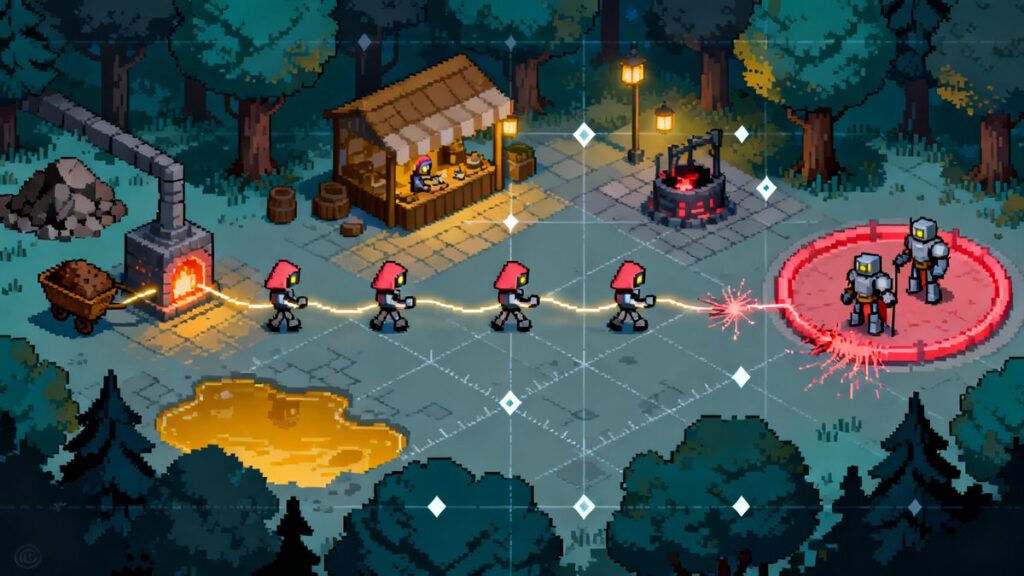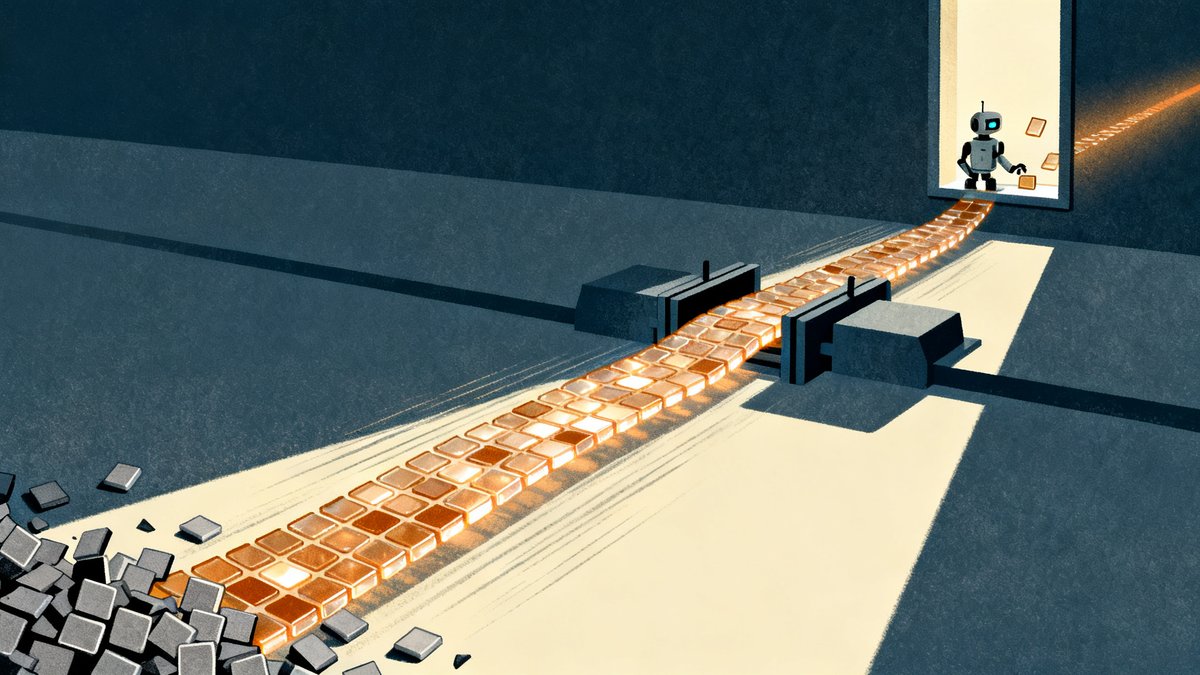
KV-streams landed on arXiv September 29, 2026, with a blunt claim: training agents that run long stops choking on GPU memory once you stop throwing the cache away. The paper, “KV-streams for Efficient Compaction in Agentic Reinforcement Learning” (arXiv 2609.35750), reports a 2.6 to 5x wall-clock speedup in training across three different compaction strategies. And the authors state they found no evidence the method hinders performance. The mechanism fits in one sentence: when you compact an agent’s context, you stream the KV cache forward instead of flushing it after each compaction. The team positions it as a plug-and-play addition to any post-training pipeline, not a new model architecture.
That last distinction matters if you build agents for clients, and I will explain why.
Long Agent Traces Hit a Memory Wall
The paper’s opening line names the constraint every agent operator meets eventually: “Scaling the horizon of agentic LLMs is bottlenecked by the need to fit ever longer context traces in GPU memory” (source). An agent that keeps working generates a trace that keeps growing, and the standard fix has been context compaction. The paper calls compaction “the most popular mechanism to alleviate this issue, keeping GPU memory constant for a given trace.” In practice, you summarize or trim what the model sees so memory stops climbing.
Compaction as commonly implemented has a flaw that gets ignored. Every time you compact, the KV cache built from all that prior context gets discarded, which means the computational work that produced it is thrown out too. You save memory and pay for it in reprocessing. That same pattern shows up in every agent pipeline I ship for clients, just billed at API prices instead of GPU prices.
What KV-streams Actually Changes
The fix, in the authors’ words: “KV-streams enable scalable compaction by streaming the KV cache forward rather than flushing it after each compaction” (source). The compressed cache persists and continues forward with the agent instead of being rebuilt at every step. The authors describe it as “a plug-and-play strategy compatible with any compaction strategy that substantially increases throughput while showing no evidence of hindering performance.” That generality is the interesting engineering claim.
This is not a new summarizer or a new eviction rule; it is plumbing that works underneath whatever compaction you already trust.
The reported numbers back the claim. The paper states KV-streams enabled three other compaction strategies and delivered “a 2.6 to 5x wall-clock speedup in training” (papers.cool mirror).
Listed authors include Emiliano Penaloza, Massimo Caccia. And Guillaume Lajoie, and the paper hit the arXiv listing on September 29, 2026 (listing).
The Finding That Matters More Than the Speedup
Speedups sell papers, but the sleeper result sits near the end of the writeup. The authors report that “the streamed KV cache can act as a recurrent state, carrying forward information that has long since disappeared from the context.” The agent retains information that is no longer visible anywhere in its prompt. Read that again: the model remembers what its context no longer contains.
My take is that this cuts both ways, and the downside deserves more attention than it is getting. On the good side, your agent stops losing details that summarization would have flattened, which is the failure mode I care about most in client work. On the bad side, the visible transcript stops being ground truth. When an agent respects a constraint or repeats a preference that exists nowhere in its current context, you cannot debug that from the logs. Audit trails, reproducibility, and prompt engineering all assume the context window contains the state. With cache streaming, the context window contains an index of the state.
For anything regulated or anything with a client’s name on it, name that trade out loud before adopting the approach. Discovering it mid-bug-hunt is worse.
What Small Operators Should Do With This
You probably do not train RL agents, and that is fine. You do run long agent loops on rented models. And you pay for every token the provider reprocesses after your summarization step fires. This paper targets training throughput today and frames KV-streams as “an efficient and lightweight plug-and-play addition to any post-training pipeline” (source). The same idea applied at serving time changes what a long agent run costs. And I expect providers to ship some version of cache streaming as the technique circulates. Watch the inference APIs.
Three moves this week:
– Count how many tokens your agent loops reprocess after each compaction event. That number is your exposure, and it is sitting in your own logs right now.
– Log what your summarization step drops. You already live with the information-loss half of this problem; KV-streams just relocates it from the prompt into hidden state.
– Stop treating the transcript as complete state. When you file agent output for a client, note that reproduction depends on cache continuity, not only on the prompt.
The Takeaway
KV-streams makes compaction cheap enough to lean on: 2.6 to 5x faster training across three strategies, no evidence of a performance hit. And a KV cache that quietly behaves like memory. The efficiency claim is the easy part to verify. The deeper shift is that the context window is becoming a view rather than the whole record. And anyone who debugs, audits, or bills for agent behavior needs to adjust assumptions accordingly.
Read the paper yourself (arXiv 2609.35750).
Then pull one long-running agent trace and count what compaction costs you today. If the number is ugly, you now know where the fix is coming from. And if you want a second pair of eyes on your agent stack, that is what my shop does.