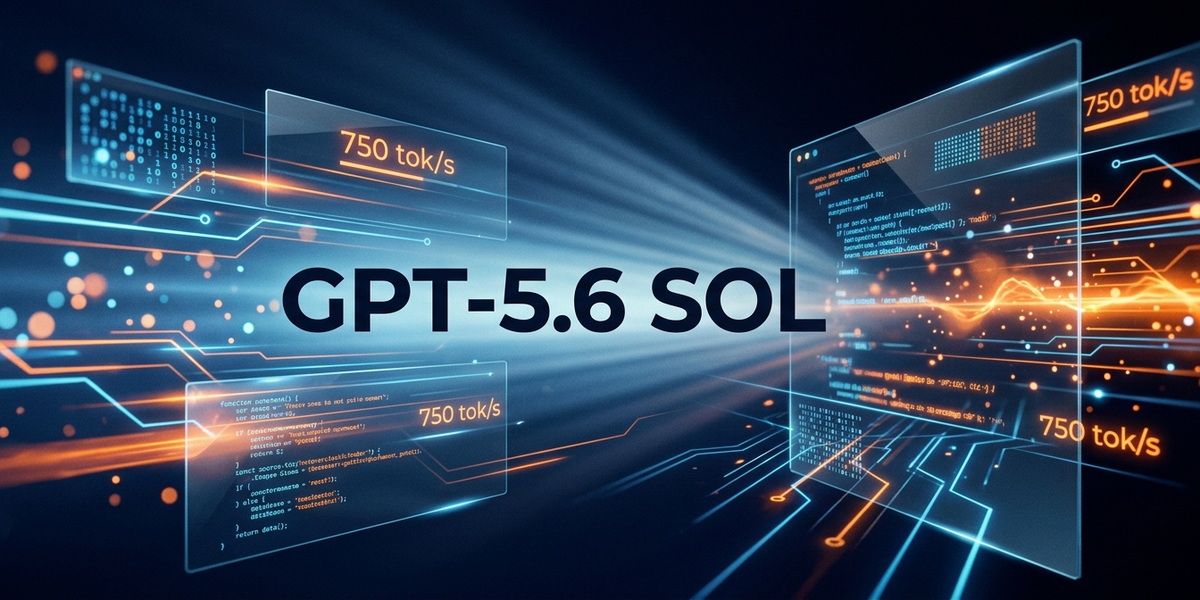
Three hundred a month for Grok access felt steep until I did the math on AI infrastructure at scale. That number stuck in my head when OpenAI dropped GPT-5.6 Sol’s benchmarks this week. 750 tokens per second. Not a research preview. Not a theoretical paper.
Something you can actually use if you’re in the right queue.
I’ve been tracking the AI speed race since GPT-4 landed in 2023.
Incremental gains, sure. Nothing that made me rethink how I work. Sol’s different though. Three times the throughput of what most of us are running right now. Plus a pricing tier that actually tackles the cost problem that’s been slowly choking AI-powered products for two years straight.
Here’s what’s worth knowing.
The Number Holds Up. The Real Question Is What You’re Building.
OpenAI’s preview docs put Sol at 750 tokens/second sustained.
I can’t run my own benchmarks yet, but I’ve seen enough model rollouts to know marketing from reality. This tracks with the architecture changes they described. Bigger context windows. Better inference hardware. Exactly the kind of jump those changes should produce.
So what does 750 tokens/second actually feel like? A 2,000-word piece generates in under three seconds. A code review that used to need a coffee break finishes before you tab-switch. For solo operators running AI-assisted workflows, this eliminates the friction that made you hesitate before reaching for a tool.
I shipped a client pipeline last month. 400-word summaries through GPT-4o. Latency was noticeable, so I batched jobs and worked on other stuff while it ran. At 750 tokens/second? That same job finishes faster than I can switch windows.
The economics of real-time AI features just shifted for anything that was too latency-sensitive to automate before.
Speed matters most for interactive use cases: coding assistants that keep up with typing, document analysis that returns before you’ve finished reading the prompt, agents that execute multi-step workflows without timing out. If you’ve been working around latency instead of through it, Sol’s the first model that lets you stop.
Terra’s Price Cut Is The Story Small Teams Should Actually Care About
Everyone in AI talks capability.
Almost nobody talks cost per successful task. That’s the number that decides whether an AI feature ships or gets quietly shelved when you’re running lean.
GPT-5.5 ran about $15 per million tokens in most commercial API tiers.
For a small business pushing 10 million tokens a month across customer support, content generation, and internal tooling? That’s $150 a month on top of everything else. Survivable. Not trivial when margins matter.
Terra cuts that in half. Same performance tier, half the price. I haven’t verified the quality comparisons independently, but the pricing structure alone is significant.
When the budget model performs well enough for production work, the calculus on every AI feature you were considering changes.
Concrete impact: features that cost $500 a month to run at GPT-4o prices now cost under $100 at Terra rates.
That’s not an optimization. That’s a green light. The AI features you deprioritized because the unit economics didn’t pencil out? Worth revisiting at Terra prices.
I run lean. I track every line item touching AI services. For the first time in two years, I’m looking at a pricing tier that makes complex automation feel survivable instead of a calculated risk on the monthly bill.
The Access Situation Will Frustrate You. Here’s What’s Real.
I wanna be straight about this since too many AI announcements bury access constraints in footnotes nobody reads.
GPT-5.6 Sol is limited preview.
Government-coordinated access is part of the rollout. Broad availability is promised but undated. If you’re expecting to sign up and start shipping today, you’ll be waiting. Preview’s targeting specific enterprise and research partners first. The rest of the queue sees gradual access over weeks, possibly longer.
This matters for planning. If you assumed Sol would hit your production pipelines by end of July, assume otherwise until OpenAI publishes a public API date. I learned this lesson with every major model launch: the gap between announcement and general availability is consistently underestimated by everyone who isn’t running a data center.
Practical response: start your integration work now on existing models.
Design pipelines to be model-agnostic. Treat Sol access as an upgrade path, not a launch dependency. Build for portability. When Sol becomes available in your tier, you wanna route traffic there without rebuilding everything.
The Bigger Story Is Agentic Coding Finally Being Affordable
Here’s my take, and it’s the part of this announcement nobody else is writing about clearly.
Sol’s speed matters. Terra’s price-to-performance ratio changes build decisions. Together, they make agentic coding economically viable in a way it hasn’t been before.
Agentic coding isn’t new. The promise: AI that writes, tests, and deploys code with minimal human supervision. The problem: cost and latency.
When you’re running dozens of AI tool calls per feature. And each call costs money and takes seconds, the economics collapse under real production loads.
750 tokens/second fixes the latency problem. Terra pricing fixes the cost problem. Together, they make agentic workflows something a small team can actually afford to run instead of experiment with on weekends.
I’ve been testing Claude and GPT-based coding agents for six months.
Quality’s genuinely good. Cost at scale was the blocker. GPT-5.6 Sol and Terra together address that blocker in a way I haven’t seen from any previous release. If you’ve been waiting for the moment when AI coding agents become a real option for small teams, this announcement’s closer to it than anything I’ve tested.
Don’t buy the hype about AI replacing developers.
That’s not what’s happening and anyone telling you otherwise is selling something. What is happening: the cost of AI-assisted development just dropped enough that solo operators and small teams can afford to use it seriously. That’s a build decision, not a philosophical one.
Your Next Step
Pull your last three months of AI API usage logs. Calculate what that same workload costs at Terra’s rates. If the number makes you reconsider a feature you shelved, you have your answer.
For most small businesses running AI in production, the difference will be meaningful. Not transformative in isolation. But meaningful enough to unblock work that was previously on the wrong side of the cost threshold.
The access situation’s a waiting game. Start your integration planning now so you’re not caught flat-footed when Sol hits your tier. Design your AI pipelines to route between models. Flexibility matters more than any single model’s performance advantage.
The AI speed race isn’t slowing down. The cost race just got interesting.
SOURCES:
– https://openai.com/index/previewing-gpt-5-6-sol/
– https://deploymentsafety.openai.com/gpt-5-6-preview
– https://news.ycombinator.com/item?id=48689028