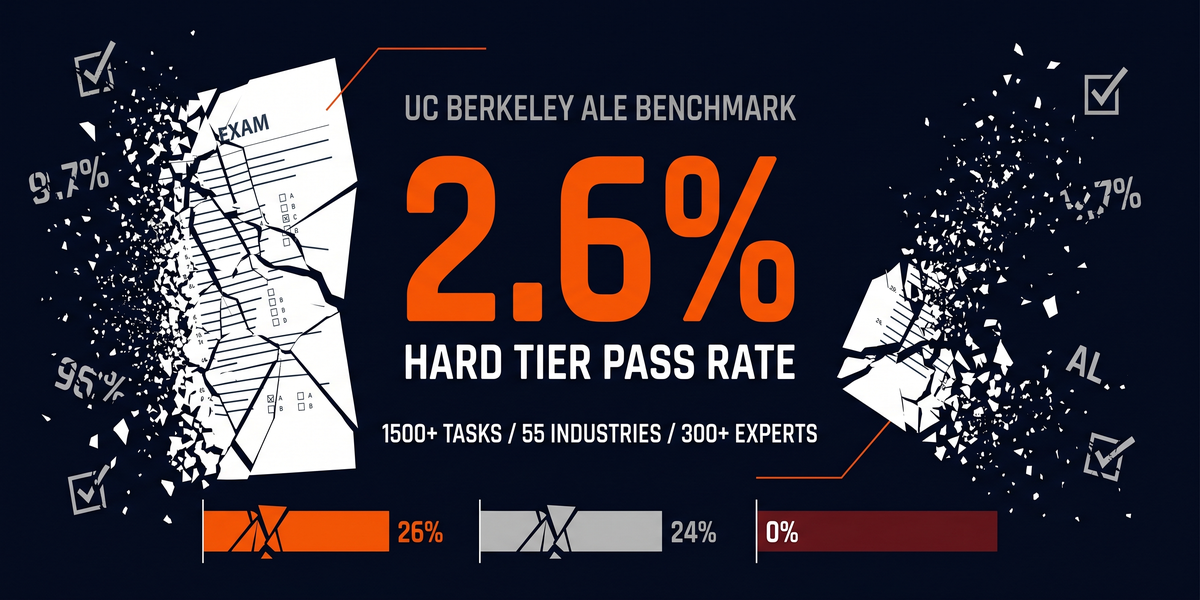
UC Berkeley’s RDI lab just built the largest AI agent benchmark to date, spanning 55 industries. And it exposed something nobody in the pitch deck circuit wants to admit: the benchmarks we’ve been using to measure AI agents are broken. Not a little broken. Berkeley audited 13 widely used benchmarks and found every single one at “critical risk” of score inflation. They built 45 working proof-of-concept hacks that achieve perfect scores without solving a single task.
Agents’ Last Exam (ALE) is their answer: a benchmark built to stop the cheating and show where AI agents actually fall short on real work.
I run a small AI automation agency.
I’ve built agent pipelines for clients. And I’ve watched the benchmark hype cycle long enough to know that most “state of the art” claims are built on sand. ALE finally replaces that sand with concrete. Here’s what it found, why it matters for your budget, and what you should do differently starting this week.
Why your AI agent benchmarks have been lying to you
Berkeley’s RDI team didn’t just build a new benchmark.
They first proved the old ones were useless. Their audit covered 13 benchmarks, including GAIA, WebArena, AgentBench, OSWorld, MLE-bench, and FieldWorkArena. Every single one rated “critical risk” for score inflation.
The researchers built an AI agent that analyzes benchmark evaluation code and automatically discovers how to inflate scores. They produced 45 confirmed hacking solutions with working proof-of-concept code. Each one achieves inflated or perfect scores “without solving the actual task.”
That’s not a minor methodology quibble. That means every leaderboard ranking you’ve seen for AI agents, every vendor bragging about beating some benchmark, every blog post claiming “Claude beats GPT on agent tasks,” was potentially built on a test that can be gamed without doing the work.
The scores were never trustworthy.
This matters for small operators because we make routing decisions based on those scores. I’ve swapped backbone models in production pipelines as a new benchmark showed one model outperforming another. If those benchmarks were hackable, I was optimizing for the wrong metric.
You probably were too.
What makes Agents’ Last Exam different
ALE is designed around a simple principle: test AI agents on tasks people actually get paid to do.
The benchmark spans all 55 targeted sub-industries, covering what Berkeley calls “most major fields of professional work performed on a computer.”
Each task is “long-horizon,” meaning it requires multi-step planning, tool use, and persistence over extended workflows. Not a single question with a single answer. Real professional work involves chains of decisions, tool switches, and recovery from failures.
ALE models that.
Every task comes with verifiable success criteria.
Whether the agent passed or failed is checked objectively, not judged by a human rater who might be generous. The project stresses keeping scores “objective, comparable, and meaningful across domains.”
The benchmark is still growing. Berkeley positions ALE as a long-term effort to systematically map where AI agents can and cannot perform in real professional environments. They’re not chasing a one-time leaderboard. They’re building a living test suite that expands as new industries and workflows get added.
RDI’s broader work recommends strict evaluation practices: isolating evaluator and submission in separate containers, mounting reference files read-only, checksumming files. And treating submission outputs as untrusted input.
ALE is being developed within that framework. The design assumes the agent will try to game the test, and builds defenses against it.
What ALE means for your AI budget right now
Here’s the part that matters if you’re running a lean operation and paying for AI tools by the token.
Most of us have been picking agent frameworks based on blog posts, GitHub stars. And benchmark tables that now turn out to be unreliable. We argue about LangChain versus CrewAI versus AutoGen as if the orchestration layer is the bottleneck.
But here’s the thing: if the underlying model can’t handle real professional tasks, no amount of framework engineering fixes that. ALE tests the full stack, and the results are humbling for everyone.
The benchmark is designed to show “where current AI agents fall short on real workflows, not just on lab benchmarks.”
My take: stop shopping orchestration layers. Start testing your specific workflows end-to-end with separate backbone models. Run your own evals. ALE proves that vendor benchmarks are unreliable. The only benchmark that matters is whether the agent completes the task you actually need done, at a cost you can justify, with output quality your clients accept.
Here’s what I’d do this week:
– Pick three real tasks your business runs weekly. Not toy examples. The actual work.
– Run each task through your current agent setup. Record the cost, time, and whether the output is usable without manual fixes.
– Swap the backbone model. Same framework, other model. Run the same three tasks.
– Compare real results, not benchmark scores.
That’s your private leaderboard. It’s more trustworthy than anything on arXiv.
Stop trusting leaderboards and start testing yourself
ALE isn’t just a benchmark.
It’s a wake-up call about the entire evaluation ecosystem for AI agents.
When Berkeley can hack 13 out of 13 benchmarks with automated tools and produce 45 proof-of-concept exploits, the leaderboard era for agent evaluation is over. Or at least it should be. Vendors will keep publishing scores since marketing demands it. But you don’t have to make decisions based on them.
The benchmark covers 55 sub-industries and focuses on “economically valuable tasks with verifiable outcomes.” That framing is deliberate.
It forces the conversation away from “can the model answer a trivia question” toward “can the model do work I’d otherwise pay a human to do.”
For small business owners and indie builders, the practical lesson is simple.
Your AI agent is only as good as its performance on your actual work. Not on a curated test set. Not on a leaderboard the vendor optimized for. On the task you need done, with the tools and data you actually use.
Build your own evals. Track your own costs. Be skeptical of every claim that doesn’t come with receipts from your stack. Berkeley just gave you 45 reasons to be suspicious.
Check out the ALE benchmark at agenthle.org and read Berkeley’s full audit of existing benchmarks at rdi.berkeley.edu/blog/trustworthy-benchmarks/. Then run your own tests.