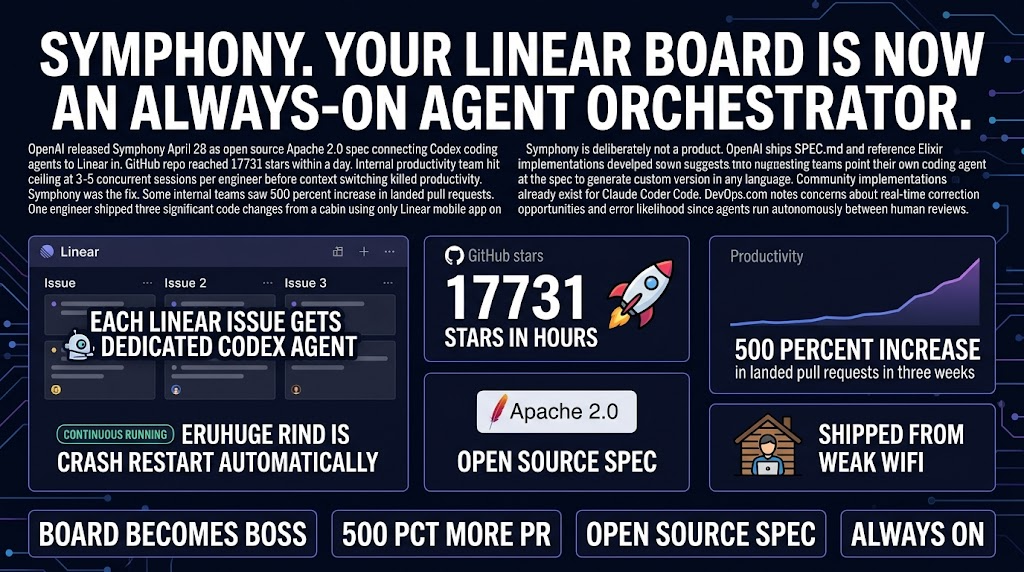
17,731 stars. In under 24 hours. OpenAI dropped Symphony on April 28 and the internet went nuts.
OK so here’s what happened. OpenAI published a spec. Not software, a spec. SPEC.md and a reference Elixir implementation. Tells you to point your coding agent at it and build your own version in whatever language you want. Community implementations for Claude Code already exist. That’s the part nobody’s writing about.
The headline was “500% more pull requests!” That’s real. Internal teams. Three weeks. Verified by InfoWorld, DevOps.com, Help Net Security. One engineer shipped three changes from a cabin using the Linear mobile app on weak wifi. Cool story. Sounds amazing.
Except.
That number came from OpenAI’s own engineers. Their repo. Their tests. Their review process. You’re reading this on your laptop in your office. Different situation.
If you’re running a small shop, you probably don’t have a CI pipeline running full tests on every PR. You probably review code yourself. Line by line. Because there’s no one else. You probably don’t have guardrails catching edge cases before they land.
Symphony gives you 500% more PRs. Doesn’t give you 500% more review capacity. Those are different problems. One solves the coding side. The other solves your calendar. You’re still the person who has to approve everything.
DevOps.com flagged something. When agents run without real-time oversight, you can’t steer them mid-flight. Works great in repos with strong test coverage and guardrails. Doesn’t work great in the rest of them. Weak tests, slow reviews? You will drown.
It gets worse. The spec itself is 47 lines. That’s the whole thing. OpenAI published a 47-line spec and the internet lost its mind. I’m not saying it’s bad. I’m saying it’s not a product. It’s a sketch.
Here’s what matters. OpenAI isn’t selling orchestration software. They’re owning the standard. USB did this to connectors. VHS did this to Betamax. Every platform play in history works this way. Get everyone to build to your spec, you control the integration point. That’s the actual move here.
If you’re selling AI services to clients, listen up. “I’ll run agents for you” goes to zero within 18 months. “I’ll design your orchestration layer” is consulting. Different business. Different future.
Before you touch Symphony. Three things. First, test coverage above 80%. Non-negotiable. Autonomous agents hit edge cases you didn’t plan for. If your tests don’t catch them, your users will. Second, PR review same day. If a PR sits open more than a day, your process is already the problem. Third, clear acceptance criteria. When an agent closes an issue, what does done mean? If you can’t answer that, you’re not ready.
Most small shops skip all three. Run one or two agents, review by gut, ship when it feels right. Works at low volume. Breaks when you scale. This tool exposes that.
Here’s the thing though. Fix the process first and the gains are real. You’re shipping more code. Your competitors are drowning in PRs they can’t review. You’re the shop with a workflow that works.
Do this. Open three agent sessions today. Not a toy project. Your real codebase. Run them for a full day. Count PRs. Time your reviews. Notice where you start cutting corners because you’re tired. That’s your ceiling. That’s where you break.
Test coverage below 80%? Go fix that. Now. Everything else is secondary.
Already feeling the squeeze? Read SPEC.md on GitHub. It’s short. See if your workflow is approaching this problem or if you’re still manually juggling two agents with time to prepare.
Side note: their documentation is a mess. Great shape, though. 47 lines. Whatever you think about OpenAI, they can write a tight spec.
If you build for clients, start repositioning. “Orchestration layer design” is a consulting engagement. “I’ll run agents for you” is a race to the bottom. Pick one.
Symphony’s not a product. It’s a mirror. Shows you exactly how much your workflow can scale. Most small shops look in and see the mess they built themselves.
Fix it before the tools force you to.
Sources
– OpenAI Symphony announcement
– GitHub: openai/symphony
– InfoWorld: OpenAI’s Symphony spec pushes coding agents from prompts to orchestration
– DevOps.com: OpenAI debuts Symphony to orchestrate coding agents at scale
– Help Net Security coverage