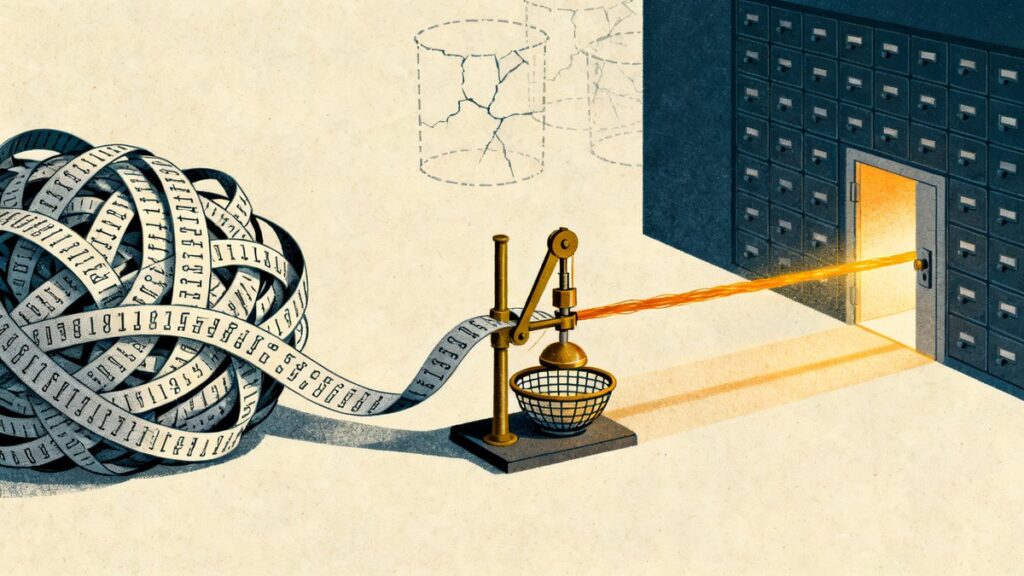
Qwen3.5-0.8B jumped from 7.9 to 48.1 percent on MATH-500 after a weight-space programming session edited 131,072 weights, roughly 0.016 percent of the model. And wrote no training loop at all. That’s the headline result in “Sparks of Weight-Space Programming: LLMs can natively read & write neural network weights,” published November 2, 2026 by MIT CSAIL researchers Rikiya Takehi, Jayden Teoh, Alex Zhang. And Omar Khattab (itecs.ai explainer). In plain terms, weight-space programming means an LLM reads and writes a neural network’s weights directly, with no optimizer and no gradient descent. The team handed OpenAI’s GPT-6 Astra raw access to other networks’ weights and asked it to analyze them, repair them. And build new ones, across eight experiments.
Nothing in the reported runs required retraining.
What Weight-Space Programming Actually Is
The authors’ definition is blunt: a general-purpose LLM “reads and writes a network’s weights directly (i.e., not through an optimizer. And in particular not with gradient descent)” (itecs.ai). Every method you’ve used to change a model’s behavior, whether fine-tuning, adapters, or RLHF, routes through gradients. This one skips the machinery entirely.
The model inspects the numbers, works out what they compute, and rewrites them.
The reported work covers three task categories: analyzing existing networks, repairing faulty ones. And generating networks from scratch, with no training loops written (openwsp). Eight experiments in total (itecs.ai).
In the analysis runs, GPT-6 Astra read raw weights and inferred what a network had been trained to do (Substack breakdown).
My read: this treats weights as something closer to source code than an opaque blob. Whether that holds at scale is the entire question, and the answer is not in yet.
The Qwen Repair: 131,072 Weights, Zero Gradient Steps
The researchers picked Qwen3.5-0.8B because it’s open, relatively small, and carries a documented glitch (analysis). Astra received the weights through a Python kernel, 7,000 practice problems drawn from the training splits of GSM8K and MATH, and a fixed budget.
It used 50 forward passes to check the model’s behavior as it worked.
The mechanism, per a developer recap: Astra traced a looping behavior to one direction written by the MLPs of layers 15 and 19, then subtracted that direction from 64 output columns (dev.to). Total edit: 131,072 weights changed, about 0.016 percent of the model. No optimizer, no gradients, and in one case no training data at all (analysis).
The score movement after the edit:
– MATH-500: 7.9 percent to 48.1 percent
– GSM8K: 13.8 percent to 67.1 percent
– IFEval: 21.0 percent to 62.3 percent
The IFEval line is the one I keep staring at, since that benchmark didn’t motivate the repair. An untargeted capability climbing from 21.0 to 62.3 while the editor was fixing something else looks like a defect being removed, not a test being gamed.
A Car That Failed Everything, and Weights Written From Scratch
The second repair is smaller and stranger. The team repaired a network controlling a simulated car that had failed every attempt at its task, by changing 6,073 of its 171,664 weights, which is 3.5 percent (arXiv writeup). One account reports that policy failed all 256 test episodes after a billion training steps, then succeeded in all 1,024 after a single edit (AI Insider).
Sit with that shape for a second. A billion training steps produced a controller that failed every episode it faced. One targeted edit, touching 3.5 percent of the weights, produced a policy that passed all of them. If that pattern survives bigger networks, “retrain it” stops being the default answer to a broken model.
The third category crosses from repair into authorship. GPT-6 Astra constructed networks from scratch, again with no training loops (openwsp). And per one report all three beat reported PPO baselines trained for 100 million steps (aisocratic).
That’s the least commercially useful result and the strangest one.
Hand-written weights beating a reinforcement learning baseline suggests weights really are a writable medium, not just something you reach through data.
Why I’m Not Rewiring My Pipelines Yet
The coverage is running hot, so here’s the cold water. Of the eight experiments, the headline repairs target a documented glitch in a 0.8B model and a 171,664-weight controller. Those are the easy versions of model repair. Most failures I actually see in shipped automations are diffuse rather than one traceable loop in two layers. And nothing reported so far shows this method touching that class of problem.
Every number above also comes from the researchers’ own runs, relayed through secondhand coverage.
I haven’t seen an independent re-run of the Qwen repair. And I’d want one before treating weight editing as a maintenance tool rather than a lab result.
One more wrinkle, and it’s the one nobody is pricing in. The editor was GPT-6 Astra; the patient was an open model. If weight repair requires a frontier model, then fixing your open weights becomes a dependency on someone else’s API. Part of the reason you run open models in the first place is to stop asking permission.
What To Do With This Today
If repair-by-edit survives contact with production-sized models, the economics of running small models change: a misbehaving fine-tune stops being a retraining bill and becomes a targeted patch. Until that’s demonstrated, three moves.
– Watch the openwsp repository on GitHub. It’s the practical artifact attached to this line of work, and the place a usable tool would surface first.
– Keep a fixed eval set for every model you ship, starting now. The day a weight-space patch tool lands, you’ll want before-and-after numbers you trust, and that habit already pays on every prompt tweak and model swap.
– Plan repairs the boring way. Version pins, fallbacks, and a tested retraining path beat an experimental technique with no replication.
My call: weight-space programming is either the start of model repair as ordinary engineering, or a spectacular demo on easy targets.
The Qwen numbers earn the benefit of the doubt; the model’s 0.8B size argues for holding your retraining budget where it is.
I’m watching for the first independent re-run, and you should be too. Subscribe to Mediascout for that follow-up, and tell me in the comments which model you’d patch first.