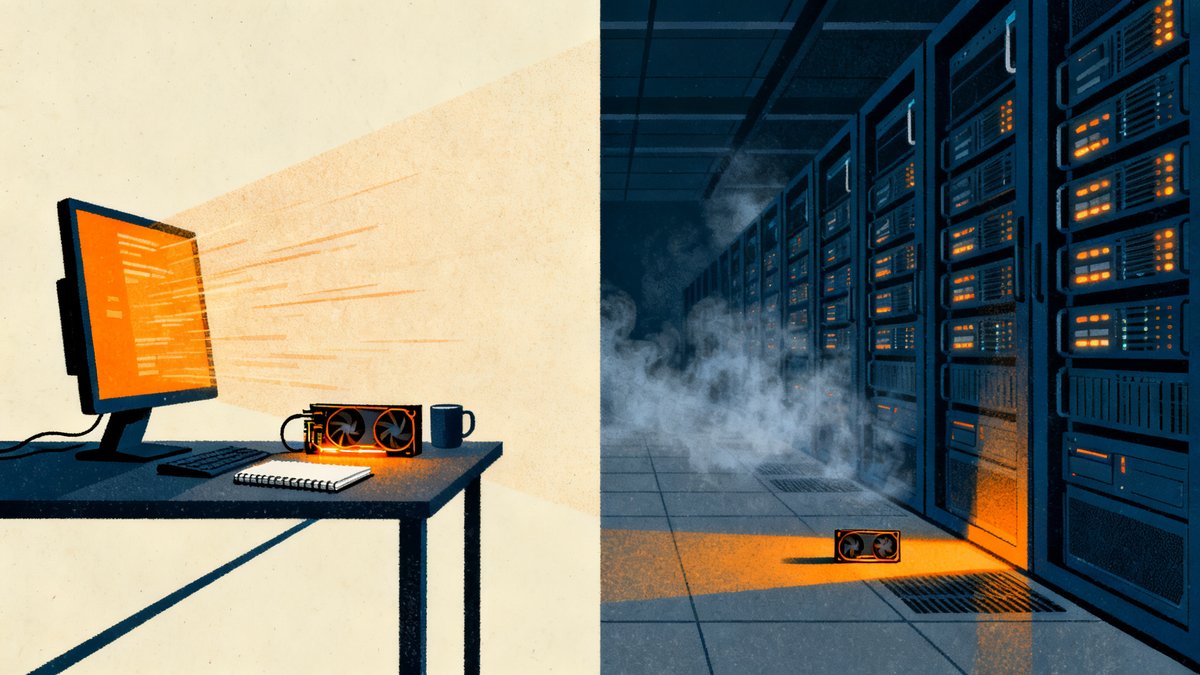
Qwen3.8-27B proves self-hosted Chinese AI models for enterprise coding don’t need a datacenter.
It ships under Apache 2.0 with a 262,000-token context window, it runs on a single workstation or high-end laptop.
And it has been downloadable since August 14, 2026 through Hugging Face and ModelScope. Pair it with the open-source terminal coding agent in the same QwenLM GitHub enterprise and you own the entire stack. The flagships grabbing the headlines, Qwen3.8 Max at 2.4 trillion parameters and DeepSeek-V4-Pro with an official eight-GPU serving recipe, are a different purchase order entirely. One GPU versus eight is the whole decision. And everything else in this market is noise until you know which side you’re on.
The One-GPU Answer Is Qwen3.8-27B
Alibaba previously kept its Max-class flagships proprietary, and in August it posted weights for both tiers at once (Toloka).
The same source describes Qwen3.8-27B as “a natively multimodal dense model under Apache 2.0 with a 262,000 token context window that is built to run on a single workstation or high-end laptop,” and calls it “the realistic self-hosting option” while writing off the Max checkpoint as “a multi-node datacenter artifact.” The Max itself is a 2.4-trillion-parameter mixture-of-experts with about 95 billion active parameters per token, close to a million tokens of context.
And up to 131,000 output tokens, released August 3, 2026.
All of that is real. And none of it changes the fact that you are not racking 2.4 trillion parameters next to your desk.
For coding work specifically, a model listing says the 27B combines Gated DeltaNet with Qwen Sparse Attention, handles 262,144 tokens natively and stretches to one million with YaRN. And targets coding, office, visual, and long-context workloads (OpenModels). The official Qwen repository dated the 27B’s availability August 14, 2026 (EcomStation). My read after watching this tier for a while: when a lab ships a flagship and a laptop-sized sibling in the same month, the sibling is the product and the flagship is the press release.
Eight GPUs Still Gets You Less Context Than The API
DeepSeek’s V4 family, previewed in April with a one-million-token context window as the default across its services, is the name that comes up first in every self-hosting conversation (Toloka).
The V4 Pro model card lists V4-Flash at 284 billion total parameters with 13 billion active (Mixroute).
Pro is where the hardware bill lands.
A deployment comparison reports that the vLLM recipe requires eight H200 or B300-class GPUs.
And even then “the 8×H200 configuration is limited to an 800K context per the official recipe and is not functionally equivalent to the 1M API,” with key-value cache headroom named as the reason; a separate publisher example runs on four GB300s (Zenn).
Z.ai, formerly Zhipu AI, plays the same game with GLM. And its GLM-5.3 is reported at roughly 750 billion total parameters with about 40 billion active per request, sharing its base with GLM-5.2 (Mixroute). The pattern repeats across every family: the numbers that win comparisons are API numbers. Your own deployment serves whatever your KV-cache memory allows, and you learn that number after the invoice clears. I would not let a leaderboard pick a self-hosting stack for that reason alone.
Apache 2.0 Until Someone Counts Your Seats
The license spread across the Chinese labs is wider than most buyers check. DeepSeek and Xiaomi publish under the MIT licence and Qwen’s smaller models under Apache 2.0, while Moonshot, Z.ai. And MiniMax use custom licences that “can add attribution requirements or commercial conditions for large deployments” (Toloka). Then there is the wrinkle inside the wrinkle. One tracker states flatly that for Qwen, “Commercial self-hosting requires enterprise commercial license agreement from Alibaba Tongyi Lab” (AI Update Watch), which sits awkwardly next to an Apache 2.0 label on the same weights.
Two sources, two stories, same model family. I won’t tell you which one a court would believe. And you shouldn’t build a production pipeline on either headline. For a two-person shop, the MIT and Apache 2.0 rows are the sane default.
For a real enterprise with hundreds of seats, “large deployments” is the exact phrase that turns a free download into a negotiation.
So get the answer in writing before a single line of your coding pipeline depends on those weights.
What A Solo Operator Should Actually Do
The model is only half the stack, and the other half is open now too. The QwenLM GitHub enterprise lists 61 repositories, including “an open-source AI coding agent that lives in your terminal” (QwenLM). That is the real shape of self-hosted Chinese AI models: weights you downloaded, an agent you can read. And no vendor sitting between them. The hardware comparison puts the cost case within reach for the previous-generation 27B, with the SGLang cookbook showing a single H100, H200, or B200, the vLLM FP8 build needing one 40GB-class GPU. And the workstation case priced around one 96GB-class card (Zenn). Those recipes target Qwen3.6-27B, not the 3.8 release, but they tell you the size class you’re shopping in.
Your checklist, in order:
– Pick by GPU budget first. One workstation-class card points you at the 27B tier; anything larger is an infrastructure project with a pager attached.
– Download Qwen3.8-27B from Hugging Face or ModelScope, point the terminal agent at it, and run it for one sprint on repositories you already know cold.
– Get the license answer for your seat count in writing before anything ships to production.
– Treat every context-window claim as an API number, and measure what your own serving setup actually delivers.
The Takeaway: Own The Boring Tier
The interesting part of this market isn’t the 2.4-trillion-parameter flex. It’s that the boring tier now ships with everything attached: Apache 2.0 weights, a quarter-million tokens of context, a terminal coding agent. And a hardware bill that fits one machine. Enterprise coding doesn’t need the leaderboard winner, it needs a model your people can serve, inspect, and keep. Run the 27B against your own repositories for one sprint, with the license question answered in writing, before you commit to anything. If it holds up, you own the stack outright. If it flops, you found out for the price of electricity instead of a contract.