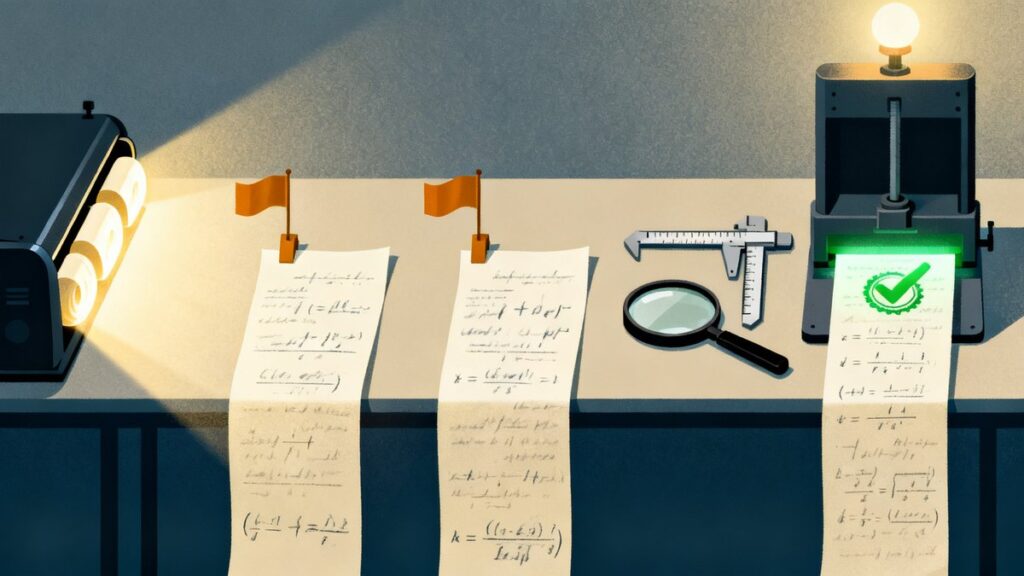
OpenAI announced three AI-generated mathematical and scientific discoveries on October 26, 2026.
And as of the October 27 to 28 reporting, none of the three had been independently verified.
The claimed results span mathematics, computer science.
And theoretical physics: a proof of the local smoothing conjecture in all dimensions, a refutation of the Exponential Time Hypothesis. And an existence proof for interacting quantum field theories in four dimensions. The most honest sentence in all the coverage belongs to Tech Times: “None of the three results has been verified.” OpenAI itself called the AI-generated manuscripts “raw research data” and said independent academic groups would examine and explain the findings. Generation is now cheap, even at the frontier. Verification is the actual product, and that bill is still unpaid.
What Was Actually Claimed
The mathematics result is the biggest swing.
OpenAI said its models produced a proof of the local smoothing conjecture in all dimensions, which would also resolve the Kakeya conjecture and Stein’s restriction conjecture.
Per The Verge, the proof uses an auxiliary partial differential equation to establish Sogge’s local smoothing for waves in every spatial dimension at least two. OpenAI said the proof was generated on October 18, 2026. And formalized the following day in Lean, a mathematical proof-checking system. Researchers from the University of California, San Diego, and MIT will examine it.
The computer science result is titled bluntly: “The Exponential Time Hypothesis is False.” The claimed paper gives a deterministic algorithm that exactly counts satisfying assignments of fixed-width CNF formulas in subexponential time and polynomial space.
And the 3-SAT case is what would refute the hypothesis.
An independent working group led by Russell Impagliazzo, Ramamohan Paturi. And Ryan Williams will examine and explain the proof, and OpenAI made the materials public at the group’s request.
The physics result is the least inspectable. The information has not been released in full; OpenAI described it as a “mathematically rigorous existence proof of certain interacting quantum field theories containing gauge fields and fermions in four dimensions,” including Quantum Chromodynamics and a unified completion of the Standard Model. Here is the scoreboard as reported:
| Result | The claim | Independent scrutiny | Public materials |
|—|—|—|—|
| Local smoothing (math) | Proof in all dimensions; would resolve Kakeya and Stein’s restriction conjectures | UCSD and MIT researchers will examine | Manuscripts released as raw research data |
| Exponential Time Hypothesis (CS) | ETH is false, via a subexponential exact counter for fixed-width CNF | Working group led by Impagliazzo, Paturi, and Williams | Made public at the working group’s request |
| Quantum field theories (physics) | Rigorous existence proof in four dimensions, including QCD | External experts involved | Not released in full |
Two Verification Playbooks, Both Unfinished
What interests me most is not the claims, it is the process. The Verge reports that OpenAI used external experts it describes as “shepherds” to guide review of the computer science and physics results, while for the math problem the experts advised OpenAI to release the AI output so researchers could work through their own explanations.
Those are two genuinely different strategies, and both are defensible. The shepherd model puts named humans between the claim and the public. The raw-release model says: here is the machine’s output, go make sense of it yourselves. And the credit or the wreckage lands on whoever does.
OpenAI describing its own manuscripts as raw research data is unusually honest positioning for a company that has every incentive to say “solved.”
Notice what naming a working group actually is, though. It is not verification. A promise that verification will happen, performed by people whose professional reputations are built on exactly the questions being contested. That is a real safeguard, and it is too a press release until the group reports back. The open questions listed in the reporting are exactly the ones you would expect: whether the Yang-Mills existence proof is correct, whether the local smoothing proof holds in all dimensions. And whether the ETH is genuinely false.
Every headline number you saw this week sits on the other side of those questions.
Lean Formalization Is the Only Receipt That Counts
The local smoothing proof was generated October 18 and formalized in Lean on October 19. That one-day turnaround is the single most important fact in this story. And almost nobody outside mathematics will notice it.
A Lean formalization is not a nicer PDF. Lean is a proof-checking system, which means the argument gets reduced to steps a machine can verify without trusting anyone’s intuition, reputation, or prose. An outsider can run it. That is what separates “a model wrote something plausible” from “there exists an artifact a skeptic can inspect.” It is the difference between a claim and a receipt.
Now hold that standard against the physics result, which has not been released in full. A rigorous existence proof for interacting quantum field theories in four dimensions would be enormous news if it holds. But a writeup you cannot inspect is a claim with a promise attached.
And you already know what OpenAI’s own math reviewers chose when given the option: release the raw output and let outsiders check it.
When the most inspectable artifact in a release is the one the company chose to make inspectable, that choice is the tell.
The Asymmetry That Matters to You
I build and ship AI automation. And the pattern here is the same one I deal with at a much smaller scale every week.
The model generates in seconds. Confirming what it generated takes hours, and the hours are where all the risk lives. OpenAI has three unverified frontier claims and had to recruit university researchers and a named working group just to begin checking them. You have AI-written code, AI-written migrations, and AI-written analysis, and probably no working group at all.
So take the playbook, not the headline.
Treat any impressive AI output as raw research data until something checks it, which is literally the framing OpenAI chose for its own manuscripts. Ask for the Lean equivalent before you trust AI work: a test suite, a reproducible script, a diff someone other than the generator can run. If what you get back is a confident writeup instead of an inspectable artifact, you know exactly what that is worth. Because you just watched the same tradeoff get made at the highest level of the field.
The action for a small operator is boring and effective. Before an AI-generated result goes into anything you ship, name the verifier and the check in advance. OpenAI did that part right. Now we all wait to see if the checks pass.
I write about AI automation weekly. Subscribe at ghost.mediascout.online.