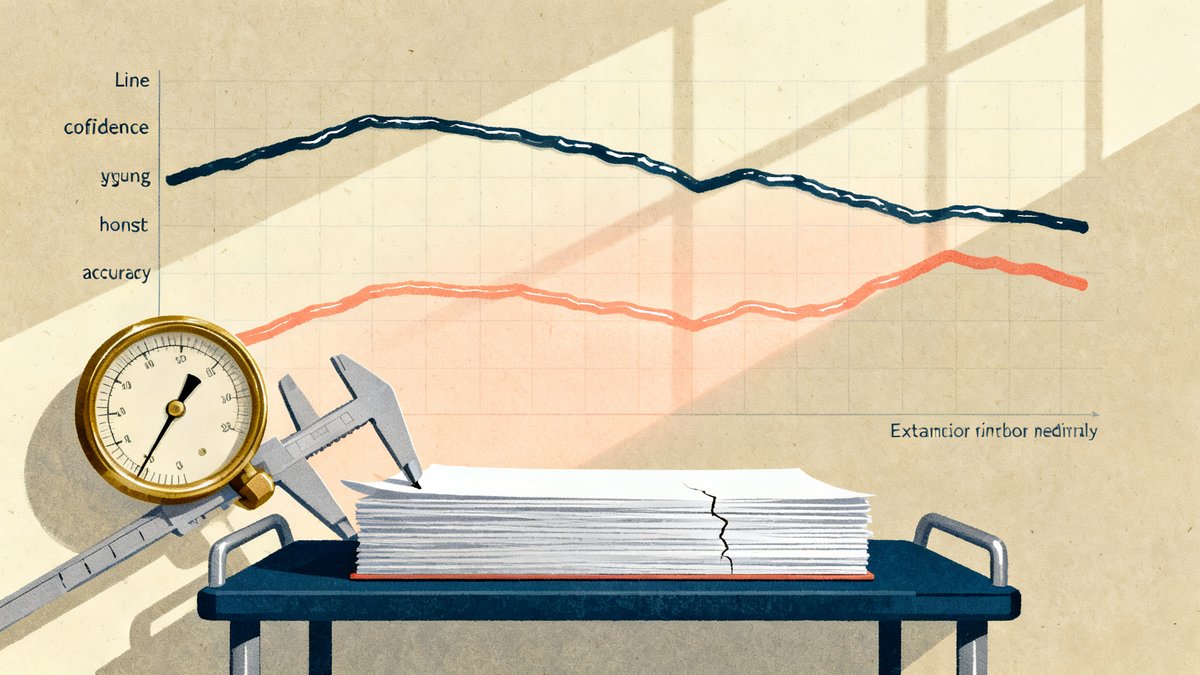
A preregistered study (arXiv 2605.23909) just gave LLM overconfidence a formal diagnosis: “too sure they are right.” Confidence exceeds accuracy, on average. That single finding explains most of what goes wrong when you put a frontier model inside an agent and hand it real work.
If you want the short version: overclaiming is now measurable, and it is reducible.
Researchers measure it with calibration metrics, Expected Calibration Error and Brier scores, reported alongside accuracy instead of in place of it, plus dedicated test suites like LifeEval, which probes the confidence-accuracy gap across difficulty levels. They reduce it with interactive calibration strategies, which a 2026 ACL paper shows empirically cut calibration error. And with a stratified playbook that pairs uncertainty estimation and reasoning-consistency checks with knowledge grounding. The rest of this post is what those findings mean for those of us shipping agents for clients who read the output, not the logs.
Confident Guessing Is the Failure Mode That Costs You
The ACL 2026 paper “Demystifying Uncertainty in LLMs: Active Calibration between Model Concepts and Human Evaluations” states the root cause in one line: “Hallucinations arise when large language models (LLMs) guess rather than acknowledge their underlying uncertainty.” The model does not flag the gap between what it knows and what it is asserting.
It fills that gap with fluent prose and keeps going.
A 2025 survey, “A Survey on Hallucination in Large Language Models,” consolidates the working definition the field leans on: output that is “fluent and syntactically correct but factually inaccurate or unsupported by external evidence.” Read that definition twice. The failure is not visible in the writing, because the writing is the camouflage.
That is why overclaiming is an operator problem before it is a research problem. My clients do not inspect token probabilities. They read deliverables. An agent-drafted report passes the eyeball test whether or not the claims underneath survive contact with the source material. Wrong-and-unsure is recoverable; wrong-and-certain is an unremarkable afternoon where nothing looks broken until the client’s email arrives.
The Hard-Easy Effect: Overconfidence Peaks Where the Stakes Do
The calibration study’s sharpest finding is the shape of the error, not just its average. It documents a hard-easy effect: overconfidence is greatest on difficult tests, while easy tests show substantial underconfidence. The confidence-accuracy gap “varies systematically with task difficulty,” which is why the authors built LifeEval, “a test for evaluating model calibration across levels of difficulty.”
That distribution is the worst possible shape for agent work. The tasks you delegate to an agent are the hard ones, as nobody builds an automation pipeline for work a human finishes in moments. You delegate the research, the synthesis, the drafting under constraints, the messy data transformation. That is exactly the difficulty band where the study says overconfidence peaks.
Underconfidence on easy tasks costs you friction. The agent hedges, double-checks, asks again, and you lose a little speed. Overconfidence on hard tasks costs you silent errors shipped with a straight face. One kind shows up in your logs. The other shows up in your client’s inbox.
How to Measure It: Report Calibration Next to Accuracy
The ACL paper’s most transferable argument is about reporting standards. It argues that every benchmark evaluation should carry calibration metrics, Expected Calibration Error and Brier scores, alongside accuracy. And it recommends diversity metrics such as Self-BLEU or unique n-gram ratios for generative tasks. Accuracy alone flatters overclaiming. A model can ace a benchmark and still be systematically miscalibrated, confident precisely in the cases it gets wrong.
The paper also locates where the signal lives: “calibration error identifies informative queries and that calibration can be accelerated by shifting query distributions from imbalanced to balanced regimes.” Translated to a small shop: your error is not uniform across your workload.
Some queries are informative in the technical sense that they expose the gap between what the model believes and what is true.
Those are the queries worth instrumenting, not the easy ones your agent already handles.
The habit worth stealing from all this: for each agent output, log two things separately, whether it was right and how sure it sounded. Divergence between those two columns over a stretch of real traffic is a more honest reliability report than any vendor leaderboard. It is the spreadsheet version of Expected Calibration Error, and it costs you nothing but discipline.
Reducing It: Root Cause First, Then Stratified Fixes
A 2026 arXiv framework paper treats hallucination management as an operational loop: “a comprehensive operational framework for hallucination management, built on a continuous improvement cycle driven by root cause awareness.” It sorts failure sources into model-related, data-related.
And context-related factors, then applies stratified mitigation, combining uncertainty estimation and reasoning-consistency checks with knowledge grounding and confidence calibration.
The structure matters more than any single technique inside it. This is the same discipline you already apply to a flaky deploy or a slow query: classify the failure source before you reach for a fix. A context failure, where the model never had the document, gets knowledge grounding. A model failure, where it knew better and guessed anyway, gets calibration work.
Treating every miss with a generic prompt tweak is how small operators burn weeks.
On the calibration side, the ACL results are the encouraging half of this story: interactive calibration strategies empirically reduce calibration error and improve reliability. Confidence is tunable, not fixed.
The guess-instead-of-acknowledge behavior responds to intervention, which is more than you can say for most production gremlins.
Overclaiming Now Has a Paper Trail
The takeaway if you ship agents into small businesses: LLM overconfidence stopped being a vibe. It has a definition, a measurement methodology. And a mitigation playbook. And the researchers behind both papers expect calibration numbers to sit next to accuracy in every serious evaluation. When a vendor quotes accuracy alone, ask for Expected Calibration Error.
The silence that follows is information.
What I would do this week is simple.
Pull your agent’s recent outputs and build the two-column audit: right or wrong in one column, how confident it sounded in the other. Read the hard cases closest, since the hard-easy effect says that is where the gap peaks. Then sort your misses into model, data, or context causes before you change anything.
If you want a second pair of eyes on an agent pipeline that swears it is fine, that is what my agency does.
Run the audit first either way. The gap you find is your real reliability number, and unlike the vendor’s benchmark, it belongs to you.