Most small businesses running AI phone assistants are paying for a voicemail system dressed up as automation.
They spend $200 a month on a voice AI that greets callers, collects some info, then transfers to a human for everything that actually matters. That’s not AI phone support. That’s an expensive intake form with a robot voice.
Something just shifted. And if you’re still signing annual contracts with voice AI vendors based on demos and case studies, you’re leaving money on the table.
The Benchmark That Actually Matters (And Why Vendors Won’t Show You It)
Every voice AI vendor has benchmark numbers. Most of them are useless.
They’re measured in clean rooms. Perfect audio. Native English speakers. No background noise, no interruptions, no accents. In those conditions, most modern models score fine. The problem is your customers don’t live in clean rooms.
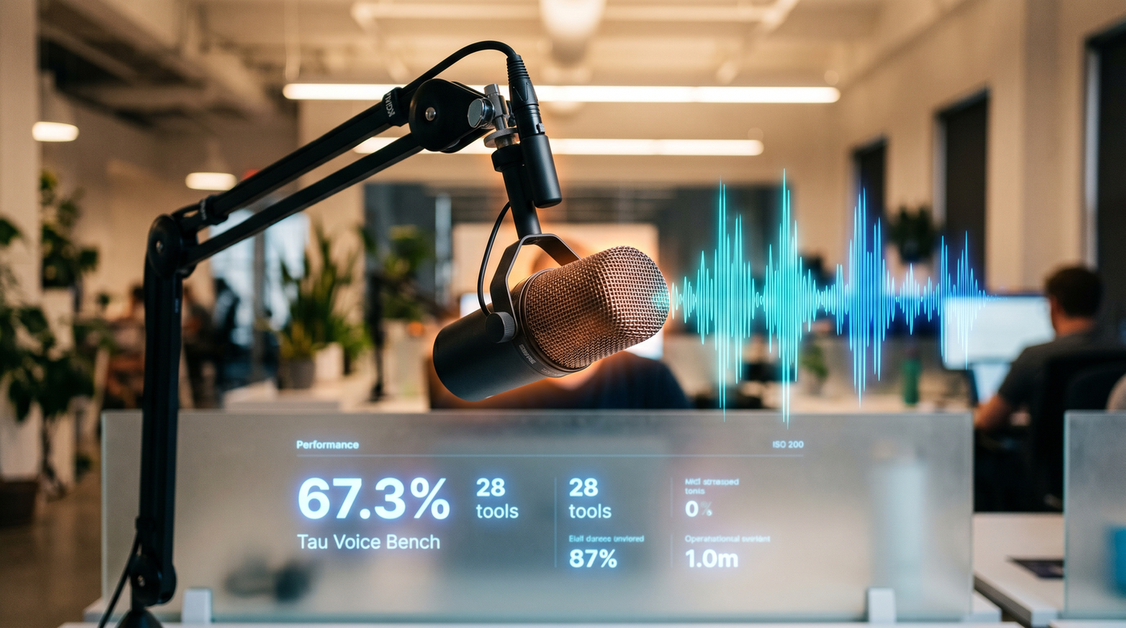
Tau Voice Bench is different. It stress-tests models in conditions that actually happen: background noise, connection drops, accented speech, mid-conversation interruptions. Grok Voice Think Fast 1.0 scored 67.3% there. The competitors it’s replacing? They’re sitting at 26-38% in the same conditions.
That gap isn’t a rounding error.
If you’re evaluating voice AI vendors this week, ask for their Tau Voice Bench score before you watch any demo. If they dodge the question, that’s your answer.
Here’s the thing. A vendor who won’t show you their real-world benchmark numbers is hiding something. They’re probably selling you the 26% version and hoping you never run it against a crowded storefront or a barking dog in the background.
The $0.05/min Price Point Nobody Is Talking About Enough
The Grok Voice Think Fast 1.0 release is getting framed as a benchmark story. That’s wrong. The benchmark story is secondary.
The primary story is pricing.
Most voice AI products are priced to be profitable at scale, not to be adopted by operators who need to make the math work on a tight call volume. At $0.05 per minute, with a 70% autonomous resolution rate, a 5-minute customer service call costs roughly $0.25 and resolves without a human 7 out of 10 times.
Do that math against what you’re paying now.
The incumbents charge $2-5 per minute with escalation rates that push most interactions to a human anyway. You’re not just paying for the AI minutes. You’re paying for the minutes the AI can’t handle, the handoff overhead, the training, the contracts.
For a solo operator or small agency running a product support line, this is a completely different cost structure. This is the difference between AI that makes your burn rate worse and AI that actually reduces headcount costs.
But it gets worse. Most businesses don’t actually know what their AI resolution rate is. They signed a contract, they turned it on, and they assume it’s working. They’re not tracking whether the AI is resolving calls or just collecting messages until a human takes over.
Before you sign anything with an incumbent vendor, measure what you’re actually getting. You might be paying for the fancy voicemail problem and not even know it.
Why 28 Tool Integrations Separates Real Agents From Fancy Toys
There’s a version of voice AI that answers questions. Then there’s a version that completes transactions.
Most products in the market are the first kind. They sound impressive in demos. They handle the happy path. But the moment a customer needs something specific, the AI hits a wall and transfers.
Grok Voice Think Fast 1.0 runs 28 simultaneous tool integrations in real time. It can look up account status, update records, process refunds, pull order history, escalate with full context already summarized, and complete the action without a human in the loop.
That sounds technical. Here’s what it actually means.
A customer calls about a shipping problem. The AI pulls the order, sees the tracking number, finds the delay reason, and either resolves it or escalates with everything the human agent needs to finish the call in one shot. No repeat explaining. No hold time while someone digs through systems.
The real kicker: businesses running this in production via Starlink are seeing 70% autonomous resolution and 20% sales conversion on the calls that would have dropped or gone to voicemail before.
Twenty percent conversion on outbound or inbound support calls is not a small number. For a business doing volume, that’s real revenue.
If your AI phone assistant still ends every conversation with “I’ll transfer you to a human,” you don’t have an AI phone assistant. You have a voicemail system with better audio quality. And you’re probably paying premium prices for it.
What You Actually Do With This
I’m not going to tell you to rush out and switch providers tomorrow. That’s not how operational decisions work.
But here’s what you should do this week.
Pull your current AI phone support resolution rate. Actually measure it. If you don’t have that number, ask your vendor. If they can’t give it to you or get defensive about it, that’s data too.
Run the math on your call volume at your current cost per resolved call versus what $0.05/min at 70% resolution would look like. If the numbers are close, the incumbent vendor has leverage. If the numbers are far apart, you have leverage.
Then benchmark alternatives. Specifically, ask for Tau Voice Bench numbers from any vendor you’re evaluating. It’s a five-minute question that tells you more than an hour-long demo.
The voice AI market is shifting fast. The tools that seemed expensive and underperforming six months ago are being replaced by options that actually resolve calls at a price point that makes sense for small operators.
You don’t have to move today. But if you’re making buying decisions based on what the market looked like last year, you’re probably overpaying for a fancy voicemail system.
The difference between AI that works and AI that’s just noise is smaller than you think. And it’s about to get a lot more obvious.
—
Sources: xAI Grok Voice Think Fast 1.0 | The Rift AI | Castle Crypto