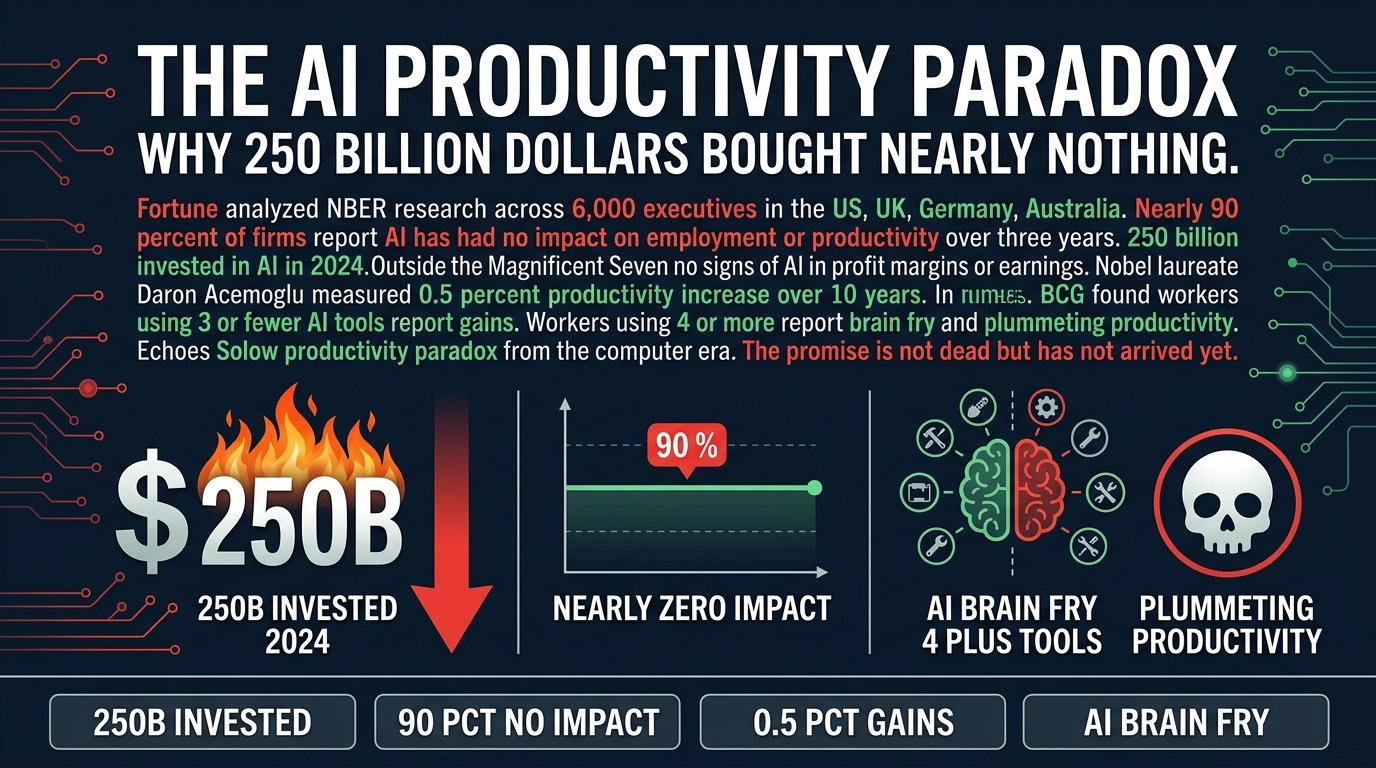
Nearly nine out of ten firms say AI has had zero impact on their business. Before you dismiss that as someone else’s problem, read this.
The AI industry has spent three years telling you that productivity gains are automatic. Plug in the tools, flip the switch, watch the efficiency roll in. The Fortune analysis of NBER research paints a different picture: nearly 90% of firms report exactly nothing. Zero. After $250 billion in AI investment in 2024 alone. The gap between the narrative and the numbers has never been wider.
The Brain Fry Effect Is Real
BCG research found a pattern that should change how you think about every AI workflow you sell or build. Workers using three or fewer AI tools report solid productivity gains. Add a fourth AI tool to the stack and productivity drops. Add a fifth and it falls off a cliff.
That is not a metaphor. The data shows a U-shaped curve. More AI does not mean more productivity. At some point, the cognitive overhead of managing multiple AI tools starts costing more than the tools themselves produce. Context switching between AI outputs. Quality control across different systems. The mental load of knowing which tool to use for which task. It adds up fast.
Think about what that means for your service offering. If you are pitching “AI-powered workflows” to clients, or if you are stuffing four AI tools into a single process because it sounds more impressive, you might be doing the opposite of what you promised. The pitch sounds modern. The outcome sounds efficient. The reality is cognitive overload and error compounding.
The practical takeaway: fewer AI tools, deployed with intention, beat an AI everything stack every time. One tool that does one job well is worth more than five tools that create coordination overhead.
What This Means for Agency Operators
The Fortune article frames this as the AI productivity paradox. I think it is more accurately described as an industry-wide billing risk.
Think about it. The AI industry sold productivity guarantees. The buyers are not seeing productivity gains. At some point, the buyers notice. CFOs read the same Fortune articles you do. They start asking questions. Why are we paying for AI automation if nothing is changing? Why does this cost more than the team we replaced?
The agencies that will survive the coming reckoning are not the ones who sold AI hardest. They are the ones who were honest about what AI does well, set realistic expectations, and delivered work that actually moved the needle on specific metrics.
What AI does well right now: first drafts, research synthesis, code generation, formatting, and repetitive tasks with clear parameters. What it does not do well: complex judgment calls, relationship management, or anything that requires understanding context across a long timeline. Being specific about that distinction is how you build a reputation that survives a market correction.
What You Should Actually Do
Not a rhetorical question. A real one. Pull up your last three client projects. What specifically did AI contribute that you can point to and measure? If you cannot answer that in two minutes, you have a positioning problem that is going to get harder to ignore.
The agencies winning right now are the ones who shifted from “AI powered” as a marketing claim to “here is the specific output AI produced and here is why it mattered.” That is a different business. It requires being honest about what AI can and cannot do. It requires building processes that use AI for what it is good at and humans for what humans are good at.
The ironic part: underdelivering on the AI promise actually makes AI more valuable, not less. When you set realistic expectations, you get work that AI genuinely excels at without the cognitive overhead of overselling. That is how you build a practice that does not collapse when clients start asking questions.
The real differentiator in this market is not selling AI. It is knowing where AI actually delivers. That knowledge is worth more than any tool in your stack.
Sources: Fortune: Why Do Thousands of CEOs Believe AI Is Not Having Impact on Productivity? | HN Discussion | NBER Research Paper