The Claude Code source leak is a security story. It is also a product story. And if you read the analysis that hit build.ms on April 1, it becomes something else entirely: a philosophy of software story.
The author is a developer who openly uses vibe coding tooling. He looked at the leaked Claude Code source, saw what everyone else saw, and then asked a different question. Not “what can we learn from the internals?” but “what does it mean that this code shipped a product generating $2.5 billion in annualized revenue?”
The answer he arrived at is uncomfortable for anyone who has spent years believing that code quality matters more than product-market fit.
Code Quality Is Not the Point
The most provocative claim in the piece is not about Undercover Mode or the regex frustration detector. It is this: the code is garbage, and that is the least interesting thing about the leak.
Claude Code is not a polished codebase. Anyone who has read the leaked source will confirm this. The architecture has rough edges. The implementation choices look like they were made fast and revised rarely. Comments are sparse in places where they should not be. The HN thread that roasted the regex sentiment analysis was deserved.
And yet.
Claude Code has generated $2.5 billion in annualized recurring revenue in under a year. Developers love it. They use it for complex refactors, autonomous testing, and bug hunting. The “Most Loved” coding agent surveys show it scoring consistently high among developers who prioritize autonomy. This is not a product that scraped by on marketing. It won because it worked.
The implication is one the software industry has been quietly refusing to confront: the connection between code quality and product value is weaker than engineers want to admit. A vibe coded product that ships fast, detects when it breaks, and rolls back automatically will outperform a beautifully engineered product that moves slowly and takes months to ship changes.
The Self-Healing Bet
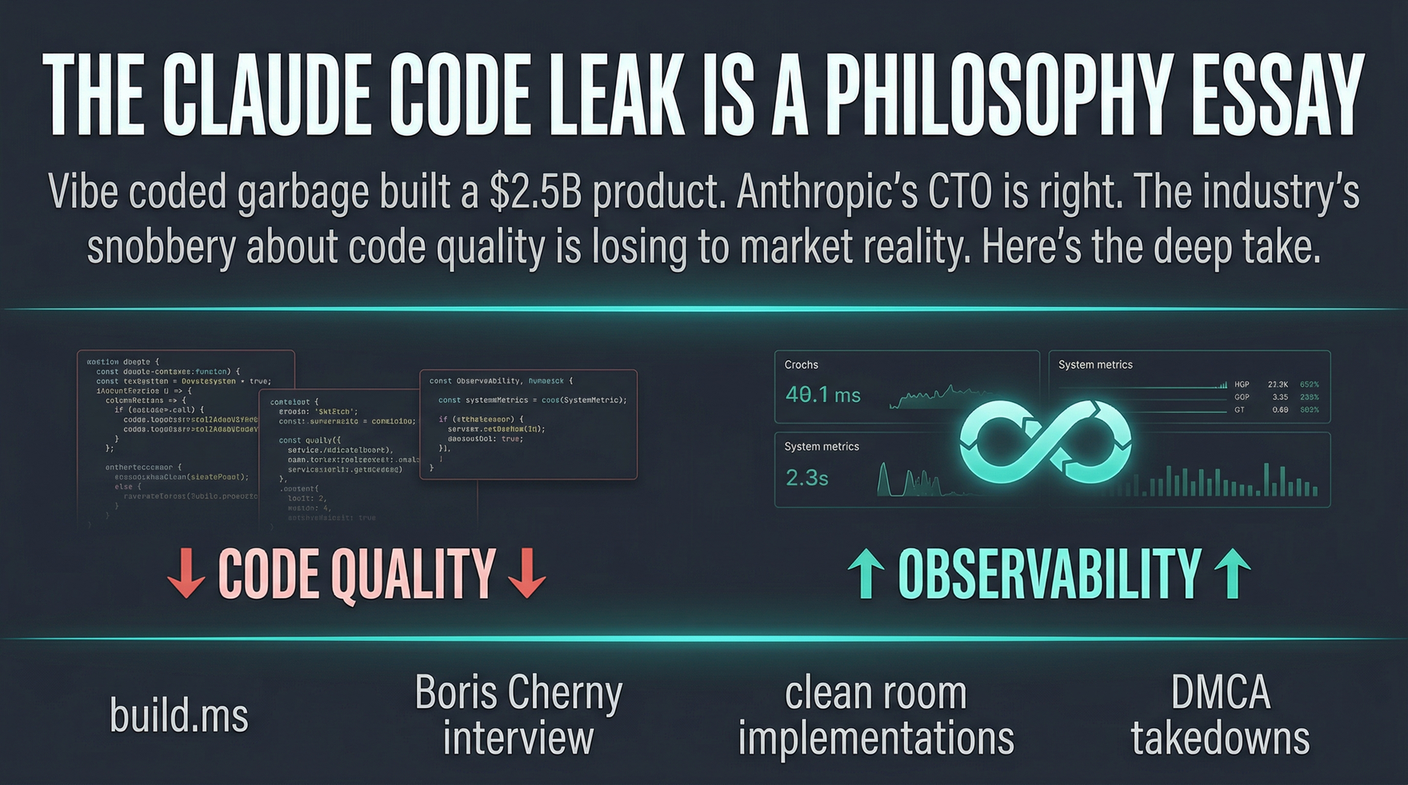
The analysis references an interview with Boris Cherny, the creator of Claude Code. Cherny explained Anthropic’s philosophy in plain terms: the team prioritizes observability and self-healing systems over traditional code quality.
This is not an accident. It is a deliberate architectural bet. If your system can detect that users cannot log in right now and automatically revert the last change that caused the problem, you can move faster. You can accept more risk at the code level because the system is designed to recover when something goes wrong.
The traditional engineering instinct is to prevent bugs from reaching users in the first place. Extensive code review, long QA cycles, conservative deployments. The Claude Code philosophy says that is the slow path. Build the safety net first. Move fast. Fix what breaks.
Whether you find this liberating or terrifying probably depends on how much you have had to clean up after a bad deployment at 2 AM. But the numbers suggest the bet is paying off. $2.5 billion in ARR does not happen by accident.
The Clean Room Problem
The leak created another problem Anthropic did not need right now. Within days, clean room implementations of Claude Code started appearing. One notable example is a Python and Rust rewrite that reproduces the core functionality without using any of Anthropic’s actual source code.
This is legal gray territory that Anthropic has not handled gracefully. Reports surfaced that the company sent DMCA takedowns to forks of its own skills and tutorial repositories. Community-contributed content got caught in the blast radius. The response has generated more goodwill damage than the original leak.
The irony is sharp. Anthropic has argued publicly that AI-generated code does not constitute derivative work and should not be subject to copyright restrictions. That argument is now being tested by their own codebase. Clean room implementations are precisely the kind of independent reproduction that copyright law has historically had to confront. Anthropic’s position on AI code rewriting is being stress-tested by developers who are now rewriting their tool from scratch.
What the Industry Gets Wrong
The build.ms piece ends with a point that deserves sitting with.
The software industry has spent decades treating code quality as a moral virtue. Clean code is good code. Technical debt is shameful. If your architecture is not elegant, you are doing it wrong.
Claude Code is a demonstration that none of that maps to market outcomes the way the industry believes. The product is beloved. It is profitable. It is changing how developers work. And the code that runs it looks like what happens when you give talented engineers two months and tell them to ship.
The industry’s snobbery about code quality is losing to market reality. Not because quality does not matter at all, but because the kind of quality that matters has shifted. System-level reliability, observability, and recovery speed are more valuable than elegant abstractions and perfect documentation.
This does not mean throw away your engineering standards. It means stop confusing the map for the territory. The goal is a product that works and serves its users. Claude Code does that. The code is beside the point.
Sources:
– build.ms — The Claude Code Leak: A Philosophy of Software
– Hacker News Discussion — Claude Code Source Leak
– InstructKR Claw Code — Clean Room Implementation