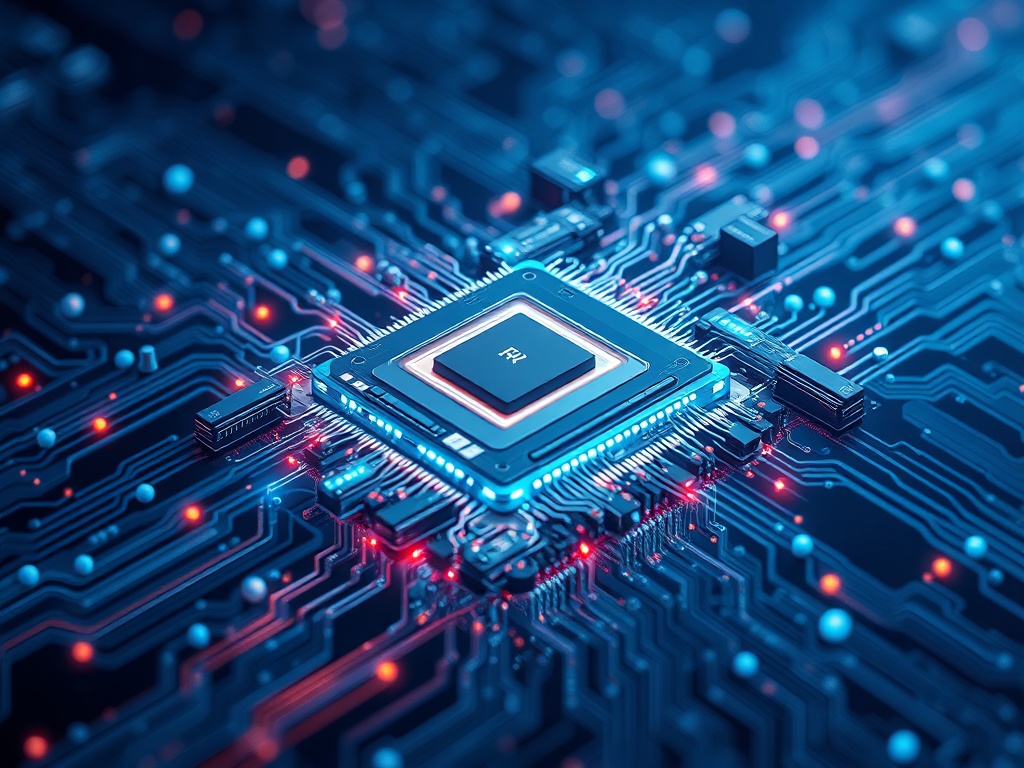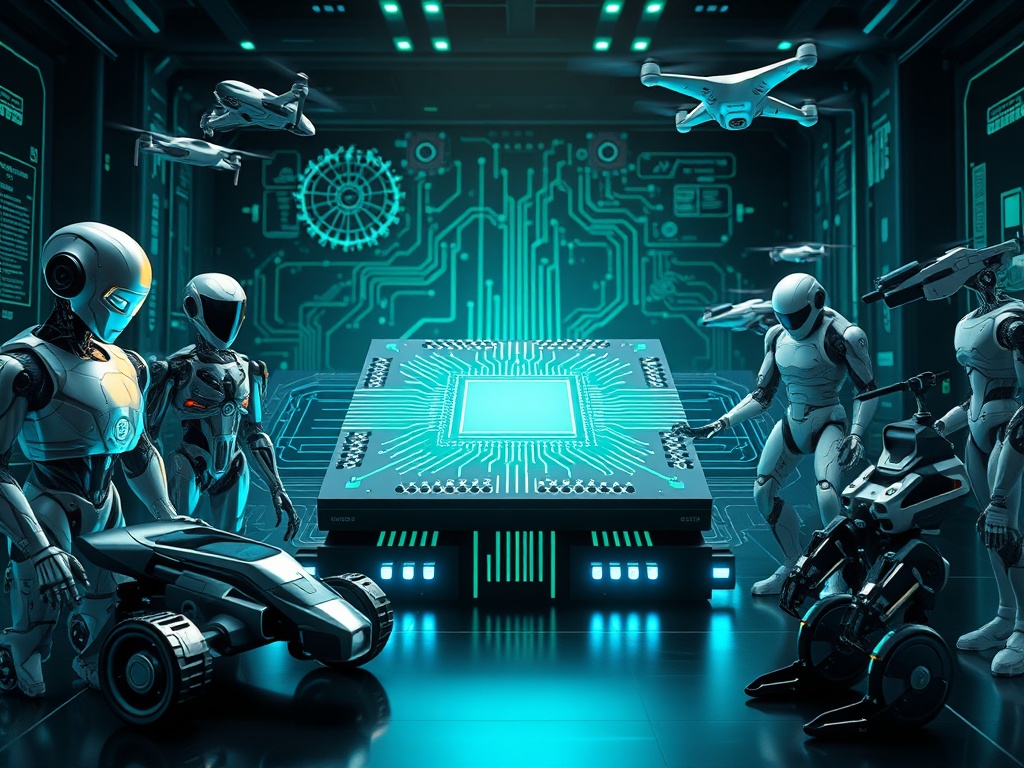
NVIDIA’s groundbreaking announcement on January 5, 2026, of the Blackwell-powered Jetson T4000 module marks a substantial leap forward for edge AI robotics. Promising fourfold improvements in energy efficiency and AI computation, this advanced AI module demonstrates exceptional performance for real-world industrial applications.
Introducing the Jetson T4000
On January 5, 2026, NVIDIA made a groundbreaking announcement that signaled a giant leap forward for the field of edge AI and industrial robotics—the unveiling of the NVIDIA Jetson T4000 module. This cutting-edge AI module, powered by NVIDIA’s Blackwell architecture, is set to redefine the parameters of efficiency and performance in edge computing. The Jetson T4000 emerges as a pivotal innovation, specifically engineered to meet the rigorous demands of modern industrial AI applications, such as autonomous vehicles, humanoid robots, warehouse automation, and more. Its introduction marks a seminal moment in the evolution of edge AI robotics, heralding a new era characterized by unprecedented capabilities and energy efficiency.
The significance of the Jetson T4000 in the landscape of edge AI cannot be overstated. At the heart of this transformative module is the Blackwell architecture, a breakthrough in AI compute technology that propels energy efficiency and AI compute performance to levels four times greater than NVIDIA’s previous Jetson Orin generation. With the capability to deliver 1,200 FP4 TFLOPS performance and equipped with 64GB of memory, the Jetson T4000 operates within a remarkably adaptable 70-watt configurable power envelope. Priced at $1,999 for 1,000-unit volumes, it represents not just a technological advancement but also a value proposition for developers and industrial operators aiming to incorporate advanced AI functionalities into their systems.
The applications of the Jetson T4000 span across a diverse array of industrial and robotics fields. From enhancing the efficiency and autonomy of humanoid robots in complex environments, to enabling high-precision operations in surgical robots, and improving navigation and manipulation in warehouse automation systems, the Jetson T4000 is poised to be a cornerstone in the development of intelligent machines. Its capacity to support advanced workloads, including real-time reasoning, sensor fusion, and multimodal data processing, makes it especially suited for the challenges of edge AI robotics.
To further its integration and applicability across various platforms, NVIDIA has ensured that the Jetson T4000 module supports new open-source physical AI models and development frameworks. This initiative encourages and facilitates a more collaborative and innovative approach to robotic development and benchmarking, empowering partners and developers to push the boundaries of what is possible with AI. Notable partners like Boston Dynamics and LG Electronics are already adopting the platform, leveraging its capabilities to enhance navigation, manipulation, and performance in household robotic tasks. NVIDIA’s CEO highlighted this release as a “breakthrough moment for robotics AI,” underscoring its influence on real-world reasoning and planning capabilities in robotics.
While the Jetson T4000 module is a formidable solution in its own right, NVIDIA also offers higher-end options such as the Jetson T5000, catering to applications that necessitate even greater performance. This tiered approach allows NVIDIA to address a wide spectrum of needs and challenges in the field of physical AI and edge robotics, solidifying its position as a leader in the industry. The expanding ecosystem around NVIDIA’s Jetson modules reflects the company’s commitment to advancing AI technologies and making them accessible for a broad range of industrial applications.
As we delve into the intricate details of the Jetson T4000’s technical specifications and the real-world implications of its performance capabilities in the next chapter, it becomes clear that NVIDIA’s latest offering is not just a product but a pivotal shift in the paradigms of edge AI robotics and industrial AI applications. Through the lens of the Jetson T4000 and its Blackwell architecture, we stand on the cusp of unlocking new dimensions in efficiency, intelligence, and functionality that will shape the future of robotics and AI at the edge.
Technical Specifications and Performance
In the realm of edge AI and industrial robotics, the unveiling of NVIDIA’s Jetson T4000 module, powered by the groundbreaking Blackwell architecture, marks a significant leap forward in technical capabilities and efficiency. This chapter delves into the technical specifications and performance attributes of the Jetson T4000, illustrating how these features translate into real-world applications and substantial performance enhancements across a spectrum of AI-driven tasks.
At the core of the Jetson T4000’s prowess is its AI performance metrics, boasting an impressive 1,200 FP4 TeraFLOPS (TFLOPS) of performance. This is a monumental stride, offering a fourfold increase in energy efficiency and AI compute performance compared to its predecessor, the Jetson Orin generation. Such a significant enhancement in performance metrics underscores the T4000’s ability to handle more complex AI workloads swiftly and more efficiently, a crucial factor for applications requiring real-time processing and decision-making.
Memory capacity is another vital specification where the Jetson T4000 excels, with 64GB of memory. This substantial memory size is pivotal for supporting advanced AI functions like real-time reasoning, sensor fusion, and the processing of multimodal data streams, which are common requirements in industrial AI applications. The ample memory ensures smooth data handling and processing, reducing bottlenecks and enhancing overall system responsiveness.
The T4000’s design also incorporates a configurable power envelope, capped at 70 watts. This feature is especially significant for deploying AI in edge environments where power efficiency is paramount. The ability to fine-tune the power usage according to the application’s demand ensures optimal balance between performance and energy consumption, making the T4000 a highly versatile module suitable for a wide array of industrial contexts. Such configurability ensures that whether in humanoid robots, autonomous vehicles, or surgical robots, the T4000 can deliver exceptional performance without excessive power draw.
These technical advancements have tangible impacts on real-world applications. For instance, the increased processing power and energy efficiency enable more sophisticated AI models to run on edge devices, leading to better decision-making capabilities in autonomous vehicles, more nuanced interactions from humanoid robots, and greater precision in surgical robots. The module’s high memory capacity allows for complex processing tasks to be carried out locally, reducing latency and enhancing the speed and reliability of AI applications in time-sensitive environments like warehouse automation and drone navigation.
Furthermore, the flexibility offered by the T4000’s configurable power envelope allows developers and engineers to optimize their systems for energy consumption or performance as needed, catering to the specific requirements of their applications. This adaptability is crucial for the sustainable deployment of AI solutions across various industrial and robotics scenarios, promoting energy-efficient operations without compromising on computational power.
By integrating with new open-source physical AI models and development frameworks, the Jetson T4000 is set to revolutionize the way developers approach robotics AI, enabling enhanced navigation, manipulation, and operational capabilities. The partnership with leading innovators like Boston Dynamics and LG Electronics emphasizes the module’s capability to meet high industry standards and demands, further solidifying its role in pushing the boundaries of what’s possible with industrial edge AI and robotics.
In conclusion, the NVIDIA Jetson T4000, with its Blackwell architecture, represents a formidable force in the industrial AI and robotics landscape, offering unprecedented levels of performance, efficiency, and flexibility. Its specifications not only promise but deliver tangible benefits, setting a new benchmark for what edge AI modules can achieve in real-world applications.
Target Applications and Industrial Uses
The NVIDIA Jetson T4000 module, powered by the revolutionary Blackwell architecture, is set to transform the landscape of industrial AI and edge robotics. Its unmatched energy efficiency and AI compute performance, as previously delineated, lay the foundation for pioneering applications across a wide array of industrial and robotics scenarios. This chapter delves deep into the targeted use cases for the Jetson T4000, emphasizing its profound implications for enhancing navigation, manipulation, and a multitude of operational tasks within these domains.
Humanoid robots stand at the forefront of this technological revolution. The Jetson T4000 equips these robots with the capability to execute complex real-time reasoning and sensor fusion tasks, significantly enhancing their interaction with the environment. This breakthrough is pivotal for applications requiring advanced navigation and manipulation capabilities, such as assisting in intricate surgical procedures or performing hazardous tasks in industrial settings. The high AI compute performance of the Jetson T4000 allows humanoid robots to process multimodal data efficiently, ensuring precise and safe operations.
In the realm of autonomous vehicles, the Jetson T4000’s prowess is equally transformative. Vehicles equipped with this module can achieve superior levels of situational awareness and decision-making. The 1,200 FP4 TFLOPS performance enables real-time processing of vast quantities of data from sensors and cameras, facilitating advanced autonomous navigation systems that can predict and adjust to the dynamic conditions of real-world environments. Such advancements are crucial for boosting safety and reliability in autonomous transportation, from cars to drones.
Warehouse automation has also been significantly enhanced with the introduction of the Jetson T4000. Robots equipped with this module can perform more complex tasks with greater efficiency and accuracy. For instance, the module’s robust AI capabilities allow for real-time reasoning and sensor fusion, enabling robots to navigate complex warehouse environments, manage inventory, and execute pick-and-place tasks more effectively than ever before. This efficiency boost is pivotal for industries looking to optimize operations, reduce costs, and improve overall productivity.
Notably, the Jetson T4000 is making substantial strides in the development and deployment of drones for a variety of applications. From precision agriculture to infrastructure inspection, the module’s energy efficiency and powerful AI compute performance enable drones to undertake longer missions with advanced navigation and data processing capabilities. This allows for more detailed and accurate data collection, ultimately leading to more informed decision-making processes.
Partnerships with industry leaders such as Boston Dynamics and LG Electronics underscore the wide-ranging applicability and potential of the Jetson T4000 module. These collaborations are harnessing the module’s capabilities to redefine navigation and manipulation tasks in robots, making strides toward more autonomous and intelligent systems capable of performing complex tasks alongside humans or in highly dynamic environments.
The Jetson T4000 is not just a leap forward in AI performance and energy efficiency; it is a catalyst for innovation across various sectors. By enabling more sophisticated and intelligent applications, it paves the way for the next era of industrial AI and robotics. As we move forward, the integration of the Jetson T4000 with NVIDIA’s ecosystem—encompassing open-source physical AI models and development frameworks—will further facilitate the development, benchmarking, and deployment of groundbreaking robotic solutions.
Ecosystem Integration and Development Support
The NVIDIA Jetson T4000, armed with the pioneering Blackwell architecture, stands at the forefront of the Edge AI revolution, particularly in the domain of industrial AI applications. Its seamless integration into NVIDIA’s broader ecosystem, coupled with robust support for open-source physical AI models and development frameworks, marks a significant advancement in facilitating robotic development and benchmarking. This harmonization is pivotal for developers and entities venturing into the realms of humanoid robots, autonomous vehicles, and more, offering an unparalleled platform to innovate and refine AI-driven robotics.
At the heart of the Jetson T4000’s ecosystem integration is its compatibility with NVIDIA’s vast array of development tools and software. The module’s design to harness the full potential of the Blackwell architecture ensures that users can efficiently access and utilize NVIDIA’s comprehensive suite of AI and robotics development tools. This includes the renowned CUDA-X AI library, which provides a deep reservoir of GPU-accelerated libraries for AI, machine learning, and computer vision. This ecosystem is specially tailored to support advanced AI workloads, such as real-time reasoning and multimodal data processing, which are critical for industrial AI applications within edge contexts.
Furthermore, the Jetson T4000 module synergizes with NVIDIA’s open-source initiative, integrating seamlessly with physical AI models and development frameworks. This open-source avenue is designed to democratize AI technologies, allowing developers worldwide to contribute to and leverage a communal pool of resources. It encourages the proliferation of innovative solutions across various sectors, including warehouse automation and surgical robotics. By fostering an inclusive environment, NVIDIA ensures that advancements in AI and robotics are not siloed but instead shared and scaled globally.
To underscore the module’s commitment to advancing robotic development, NVIDIA offers extensive support for benchmarking these innovations. By aligning with new and existing development frameworks, the Jetson T4000 enables developers to rigorously assess and iterate on their robotic applications. This is crucial in high-stakes environments such as surgical robotics or autonomous navigation, where precision and reliability are paramount. Through detailed benchmarking tools, developers can gauge the efficacy of their implementations, ensuring that they meet the stringent requirements of industrial applications.
Partnerships play a vital role in the ecosystem surrounding the NVIDIA Jetson T4000. Esteemed collaborators, including Boston Dynamics and LG Electronics, exemplify the module’s versatility and adaptability across a spectrum of robotics applications. These partnerships not only validate the Jetson T4000’s capabilities but also enrich the ecosystem with a diverse range of use cases and development insights. Through these collaborations, NVIDIA is able to refine and expand its support, catering to the evolving needs of developers in the field of Edge AI robotics.
The adoption of the Jetson T4000 by such varied industries underscores NVIDIA’s vision for a future where AI and robotics seamlessly integrate into the fabric of daily life and industrial operations. The support provided by NVIDIA—including extensive documentation, developer forums, and direct assistance—ensures that entities leveraging the Jetson T4000 can navigate the complexities of AI implementation with confidence. This ecosystem not only facilitates the development of cutting-edge applications but also accelerates the adoption of AI across critical sectors, embodying NVIDIA’s commitment to advancing the frontiers of industrial AI and robotics.
In conclusion, the NVIDIA Jetson T4000’s integration with NVIDIA’s broader ecosystem, its support for open-source models and frameworks, and the exhaustive assistance for development and benchmarking collectively pave the way for the next era of industrial AI. As we transition into discussing the future horizons and the high-end options like the Jetson T5000, it becomes evident that NVIDIA’s roadmap for physical AI and edge robotics is both ambitious and inclusive, promising to usher in unprecedented technological advancements.
Future Horizons and High-End Options
The NVIDIA Jetson T4000, powered by the innovative Blackwell architecture, represents a significant leap forwards in the realm of Edge AI robotics and Industrial AI applications. This advanced AI module is not just a standalone innovation, but a foundational piece of NVIDIA’s broader vision for the future of physical AI and edge robotics. With its remarkable energy efficiency and AI compute performance—offering a quadrupled capability in comparison to its predecessor, the Jetson Orin—it sets a new standard for what’s possible in AI at the edge.
Looking beyond the Jetson T4000, NVIDIA’s roadmap includes even more ambitious offerings, such as the higher-end Jetson T5000. The Jetson T5000 elevates the benchmark set by the T4000, offering an unprecedented level of performance that promises to unlock new possibilities in AI-reliant industries. The contrast between the T4000 and the T5000 highlights NVIDIA’s commitment to catering to a wide range of needs within the ecosystem of physical AI and edge robotics. While the T4000 is optimized for applications requiring a balance between high performance and energy efficiency within a reasonable cost, the T5000 targets scenarios where maximum AI performance is paramount, regardless of higher energy usage and cost.
The introduction of the Jetson T4000 and its Blackwell architecture into edge AI robotics marks the beginning of a new era. This platform is uniquely suited to applications necessitating real-time reasoning, such as humanoid robots, autonomous vehicles, and surgical robots. By delivering 1,200 FP4 TFLOPS of performance with 64GB of memory, all within a 70-watt configurable power envelope, the T4000 makes it feasible to deploy advanced AI in contexts where power efficiency is critical. Furthermore, with a price set at $1,999 for 1,000-unit volumes, it offers a compelling value proposition for developers and enterprises alike.
The integration of the T4000 with open-source physical AI models and development frameworks, as detailed in the previous chapter, fosters a vibrant ecosystem for robotic development and benchmarking. This ecosystem enables NVIDIA partners, such as Boston Dynamics and LG Electronics, to incorporate advanced navigation, manipulation, and household robotic tasks into their products. However, the Jetson T4000 is just one piece of the puzzle. To fully realize the potential of physical AI and edge robotics, continuous advancement and integration of higher-end options like the Jetson T5000 are essential. These advancements will build upon the T4000’s capabilities, offering even greater performance and enabling more complex and demanding AI workloads.
As we look to the future, it’s clear that NVIDIA’s Jetson platform, with the T4000 and beyond, is poised to play a pivotal role in the evolution of physical AI and edge robotics. The company’s strategic roadmap envisions a world where robots and intelligent machines seamlessly integrate into our daily lives, enhancing efficiency, safety, and functionality. With the Blackwell architecture at its core, the Jetson platform is set to pioneer advancements in AI that were once considered the realm of science fiction. This includes the development of robots that can think, learn, and adapt in real-world environments, pushing the boundaries of what’s possible in industrial applications, autonomous vehicles, and beyond. The ongoing progress in NVIDIA’s ecosystem, with the introduction of models like the T4000 and T5000, signals a future where AI at the edge becomes more ubiquitous, intelligent, and integral to industrial innovation.
Conclusions
The NVIDIA Jetson T4000 stands as a testament to the potential of edge AI in industrial and robotics applications. By blending cutting-edge Blackwell architecture with unprecedented energy efficiency, it paves the way for innovations in autonomous systems and represents the future of physical AI.