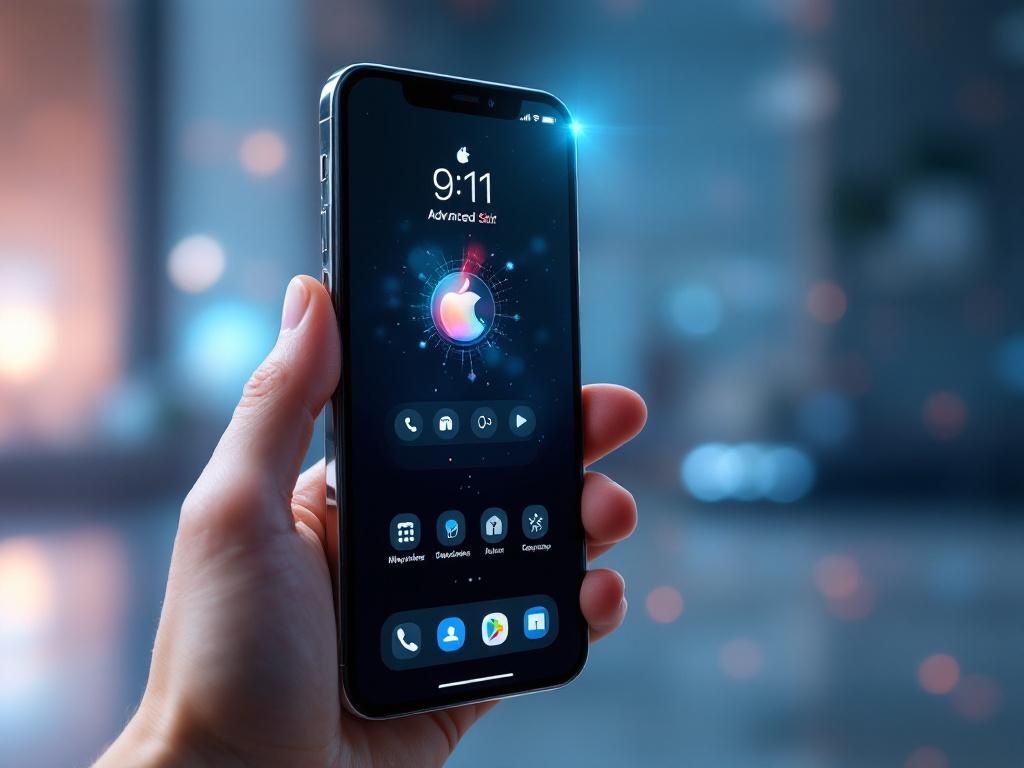
In a revolutionary move, Apple is preparing to enhance Siri with iOS 26.4, employing the prowess of Google’s Gemini AI. This will mark a significant leap forward for the beloved assistant, opening the door to new capabilities.
Siri 3.0: An Evolution Powered by Google’s Gemini
In the transformative shift of Siri, Apple is setting a significant milestone by integrating on-screen awareness and cross-app functionality into Siri with the rollout of iOS 26.4, an enhancement powered by Google’s colossal Gemini AI model. This blend of sophisticated technology marks a new frontier for Siri, elevating it to unprecedented levels of intelligence and versatility. The groundbreaking update pivots on the Gemini model’s mammoth 1.2 trillion parameters, a leap that fundamentally redefines user interaction with their devices.
Among the noteworthy advancements, the on-screen awareness capability stands out, allowing Siri to comprehend and interact with the content currently displayed on the screen. This feature enables Siri to analyze text, images, and other visual elements on the screen, thus providing context-aware responses and actions. Whether it’s extracting information from an open document, understanding visuals in a presentation, or navigating through apps based on what the user is looking at, Siri’s on-screen awareness exemplifies a quantum leap in making AI assistants more intuitive and helpful than ever before.
The journey towards achieving seamless cross-app integration represents another milestone, empowering Siri to perform actions and retrieve information across multiple apps without the user having to switch between them manually. This feature harnesses the deep learning capabilities of the Gemini model, enabling Siri to understand the context and execute tasks spanning several applications, ranging from sending messages based on details in an email to making reservations by pulling information from a calendar entry and a favorite dining app simultaneously.
Furthermore, the incorporation of Gemini’s powerful technology has facilitated personalized interactions by leveraging previous user interactions and data. Siri can now deliver more tailored responses and suggestions, reflecting an understanding of individual preferences and habits over time. This personalized approach is complemented by enhanced chatbot-style conversational abilities, akin to those inspired by ChatGPT and further refined with Gemini’s input. Through these advanced conversations, users can engage with Siri in more meaningful and natural dialogues, making the assistant feel more like a human counterpart.
This remarkable evolution of Siri is underpinned by Apple’s adoption of the Foundation Models version 10, which is built on Google’s advanced infrastructure. This strategic choice ensures that the processing capabilities required to support such complex and high-level functionalities are met with unmatched speed and accuracy. The partnership not only signifies a technological leap but also a collaborative effort that leverages the best of what each company has to offer, setting a new standard for what AI assistants can achieve.
The reimagined Siri in iOS 26.4 is poised to redefine the landscape of voice assistants, marking a pivotal moment in the advancement of AI technology. Through the combination of on-screen awareness, cross-app integration, personalized interactions, and enhanced conversational abilities, Siri is not just an assistant but a comprehensive tool that augments the user experience to an unprecedented degree. Powered by the formidable capabilities of Google’s Gemini AI model, Siri’s latest iteration signifies a future where technology seamlessly integrates into the fabric of daily life, intuitively responding to and anticipating user needs with remarkable intelligence and efficiency.
Google’s Gemini AI: The Multimodal Behemoth
In the dynamic landscape of artificial intelligence, Google’s Gemini AI model stands as a colossal presence with its 1.2 trillion parameters, setting a new benchmark for complex, multimodal AI systems. The essence of Gemini’s prowess lies in its remarkable ability to process and understand from a multitude of data types — text, audio, images, and video — simultaneously. This multimodal capability is instrumental in enhancing Siri’s functionalities in the upcoming iOS 26.4 update.
The partnership between Apple and Google, leveraging the Gemini AI model for Siri, marks a significant evolutionary leap in voice assistants. Gemini’s exceptional trait of understanding context across different data forms is a critical component contributing to Siri’s reinvented on-screen awareness and cross-app integration capabilities. Unlike traditional models that primarily focused on one type of data, Gemini’s multifaceted approach allows Siri to perceive and interpret complex queries by analyzing visible screen content, thereby offering responses that are significantly more pertinent and comprehensive.
For instance, when a user inquires about the weather while looking at a calendar event on their iPhone, Siri, powered by Gemini’s AI, can grasp the context within the screen — dates, location information from the calendar event — and combine it with external data sources to provide a specific weather forecast. This level of contextual awareness is a leap beyond Siri’s past capabilities, reflecting how Gemini’s multimodal nature enables a more integrated and seamless user experience.
Furthermore, Gemini’s design inherently supports cross-app functionalities. Its ability to harness and process data from diverse sources means that Siri can now perform actions that span across multiple applications. Whether it’s sending a message, setting a reminder based on an email, or booking a restaurant after looking up reviews, Siri can fluidly navigate through apps, courtesy of the underlying technology provided by Gemini. This cross-app integration not only simplifies tasks but also enhances productivity by creating a more cohesive ecosystem of apps.
Another pivotal feature of Gemini that enriches Siri’s capability in iOS 26.4 is its robust framework for processing natural language. Drawing from advancements similar to those seen in ChatGPT and incorporating them with Gemini’s extensive knowledge base and parameter size, Siri can now engage in more nuanced, chatbot-style conversations. This upgraded conversational ability allows Siri to understand and remember the context of an ongoing dialogue, enabling interactions that feel more natural and personalized, tracking prior user data to tailor responses accordingly.
Gemini’s AI model, with its multimodal functionalities, is intrinsically designed for advancements in privacy and security. Recognizing the paramount importance of user privacy, especially in light of Siri’s enhanced capabilities to understand and act upon more personal and sensitive information, the architecture of Gemini ensures that data processing adheres to stringent privacy standards. This ensures that while Siri becomes more capable, it also remains a secure and privacy-conscious assistant.
Transitioning towards the following chapter on Leveraging Apple Foundation Models v10, it is essential to recognize that the integration of Google’s Gemini AI not only redefines Siri’s capabilities but also sets a precedent for how Apple’s foundational models can be harmonized with external advanced infrastructures. This synergy promises not just enhancement in processing speed and accuracy but a holistic elevation in how Siri interacts, understands, and assists users, marking a significant milestone in the AI domain.
Leveraging Apple Foundation Models v10
In the burgeoning era of AI evolution, Apple’s strategic maneuver to reimagine Siri, enhanced by iOS 26.4, exemplifies a milestone in artificial intelligence integration for personal assistants. At the core of this technological marvel lies Apple Foundation Models version 10, a sophisticated framework that has been meticulously developed to harness the robust capabilities of Google’s Gemini infrastructure. This collaboration represents a confluence of Apple’s innovative vision with Google’s unparalleled AI prowess, setting the stage for an unprecedented level of AI assistant functionality.Apple’s Foundation Models v10 forms the bedrock upon which Siri’s new features are built, propelling the assistant into a new age of on-screen awareness and seamless cross-app integration. These models are designed to process and analyze vast amounts of data, drawing from a complex web of parameters that exceed 1.2 trillion, a figure that underscores the scale at which these systems operate. By integrating this foundation with the Gemini model, Siri is endowed with the ability to understand context with remarkable precision, assessing visible screen content to generate relevant, actionable responses.The technical intricacies of the Foundation Models v10 are worth noting, as they are central to the enhancement of Siri’s capabilities. These models leverage advanced machine learning techniques, including deep learning algorithms and neural network architectures, to process natural language and recognize patterns in a manner that mimics human cognitive functions. This approach enables Siri to interpret the user’s intent more accurately and execute commands that span multiple applications, effectively breaking down the silos that have traditionally impeded fluid interaction across the iOS ecosystem.Moreover, the integration of Apple’s foundational technology with Google’s infrastructure is a strategic move that benefits from the latter’s extensive computational resources and cutting-edge AI research. This synergy allows for the processing of complex queries and the delivery of responses at unprecedented speeds, ensuring that Siri’s performance is both swift and accurate. The incorporation of chatbot-style conversational abilities, a feature informed by both the ChatGPT phenomenon and the Gemini model, further amplifies Siri’s utility, offering users a more engaging and humanlike interaction experience.Personalization is another critical dimension of the new Siri, made possible by the sophisticated data analysis capabilities of the Foundation Models v10. By tracking and learning from prior user interactions, these models enable Siri to tailor its responses and suggestions to the individual’s preferences and habits. This customization enhances the user experience, making interactions with Siri not only more efficient but also more relevant and satisfying.The significance of leveraging Apple Foundation Models version 10 in conjunction with Google’s infrastructure cannot be overstated. This strategic partnership marks a pivotal moment in the evolution of AI assistants, offering a glimpse into a future where technology more seamlessly integrates into the fabric of daily life. The capacity for on-screen awareness and cross-app functionality sets a new standard for interactive computing, promising a user experience that is more intuitive, more responsive, and ultimately more useful.As Apple prepares to unveil this reimagined Siri in early 2026, with a stable launch projected for April, anticipation builds around the transformative potential of this collaboration. The deployment of Apple Foundation Models version 10, built on the advanced capabilities of Google’s Gemini model, heralds a new era in the realm of AI assistants, one characterized by unparalleled contextual understanding, enhanced personalization, and seamless interaction across the digital landscape.
Codename Campos: The Future of Siri Chatbots
Building upon the innovative strides taken with the Apple Foundation Models version 10 and its integration with Google’s cutting-edge infrastructure, Apple is on the brink of launching an advanced Siri chatbot, codenamed Campos. Set against the backdrop of a burgeoning AI landscape, where demands for smarter, more intuitive digital assistants are skyrocketing, the Campos project is a testament to Apple’s commitment to spearheading the next wave of AI communication tools. This segment delves deep into the anticipated features of Campos, its scheduled timeline for iOS 27 integration, and its potential to redefine user interaction with technology.
The Campos initiative aims to elevate the concept of virtual assistance to unprecedented levels by enabling prolonged, sophisticated conversations that can seamlessly transition across various topics without the need for a separate application. Leveraging the collaborative might of Apple and Google, particularly the 1.2 trillion parameter Gemini model, Campos is poised to offer a chatbot experience that understands and predicts user needs with remarkable accuracy. This evolution represents not merely an upgrade but a complete overhaul of Siri’s capabilities, morphing it into an entity that can understand context, recall user history, and interact in a manner truly reminiscent of human conversation.
Slated for introduction with iOS 27, which is expected to hit the market in late 2026 or early 2027, Campos is currently in the developmental phase. Given the comprehensive nature of this upgrade, tight integration with iOS is imperative. This is not just about enhancing a feature; it’s about redefining the operating system’s very core to accommodate an AI that can conduct on-device conversations. The implications for user interaction are profound, offering a level of engagement that moves beyond simple voice commands to a more nuanced, conversational interface.
One of the key features expected to set Campos apart is its on-screen awareness capability. Building on the screen content analysis introduced in iOS 26.4, Campos aims to interpret the visible elements on the screen to provide contextually relevant responses. This means that whether a user is browsing a webpage, reading an email, or looking at a photo, Campos can utilize this context to offer smarter, more accurate interactions.
Moreover, Campos will push the boundaries of cross-app integration. By understanding the functionalities and databases of different applications, it can perform complex tasks spanning multiple apps without user intervention. For instance, it could book a flight, check weather forecasts, and then summarize travel advisories by pulling data from relevant sources, thereby simplifying tasks that would traditionally require navigating through several apps and interfaces.
Personalized interactions are also a cornerstone of the Campos vision. By meticulously analyzing prior user data and preferences, Campos is designed to tailor interactions and suggest actions that resonate with the individual’s habits and tastes. This level of personalization is achieved through the advanced machine learning algorithms and models provided by the Google Gemini partnership, ensuring that conversations with Campos feel engaging and genuinely helpful.
The anticipation surrounding Campos underscores its potential impact on the AI assistant landscape. Not only does it signal Apple’s foray into next-level AI capabilities but it also sets a new benchmark for what users can expect from their digital companions. As we edge closer to its unveiling, the tech community is abuzz with the possibilities that Campos promises to bring. However, with this leap in innovation, the privacy implications become even more critical, requiring a delicate balance between leveraging user data for personalization and safeguarding their information against misuse—a challenge that will be addressed as Apple and Google continue to refine their collaborative efforts in reimagining AI interactions.
Navigating Privacy in an AI Alliance
In the increasingly interconnected world of technology, the collaboration between Apple and Google to deliver a reimagined AI-powered Siri, as part of iOS 26.4, stands as a significant testament to the merging of competencies between two tech giants. This partnership, heralding the use of Google’s Gemini AI in enhancing Siri’s capabilities, particularly in on-screen awareness and cross-app integration, also brings to the forefront a critical concern: privacy.
Privacy, a cornerstone of user trust and a fundamental aspect that both Apple and Google have vocally prioritized, emerges as a crucial area requiring rigorous scrutiny and transparent policies in this collaboration. At the heart of this partnership is the intent to leverage Google’s 1.2 trillion parameter Gemini model, a move that necessitates the sharing and processing of vast amounts of data to enable the contextual understanding and personalized interactions that the new Siri promises.
Recognizing the sensitive nature of user data, especially in interactions involving personal queries and cross-app functionalities, both companies have outlined specific measures aimed at bolstering privacy protections. Firstly, a substantial portion of processing for Siri’s advanced features is designed to occur on-device, minimizing the amount of data transmitted to servers. This approach not only reduces vulnerability to data breaches but also ensures that the personalization of Siri’s responses is grounded in the user’s device, thereby limiting external access to sensitive information.
In instances where data must be sent to servers for processing, Apple and Google have committed to employing end-to-end encryption and anonymization techniques. By stripping away identifiers that could trace data back to an individual and encrypting this information during transit, the partnership aims to safeguard user privacy while still benefiting from the advanced processing capabilities of Google’s Gemini model.
However, the collaboration raises questions about data stewardship, particularly regarding how user data will be shared between Apple and Google. In response, both companies have emphasized their adherence to stringent data-sharing agreements, explicitly stating that all shared information will be used solely for the purpose of enhancing Siri’s functionalities and not for cross-selling or advertising purposes.
The adoption of ChatGPT and Gemini’s chatbot-style conversational abilities within Siri, underpinned by Apple Foundation Models version 10, further underscores the importance of a privacy-centric approach. User interactions with an AI as sophisticated as Siri could reveal deeply personal information, preferences, and behaviors. Thus, the systems developed as part of this collaboration incorporate advanced algorithms designed to continuously evaluate and enhance privacy protections, ensuring that Siri’s learning mechanism does not inadvertently compromise user confidentiality.
Despite these comprehensive measures, potential risks remain. The interconnectedness of apps and the depth of contextual understanding that the new Siri offers could possibly create vectors for inadvertent data exposure or misuse. Consequently, both Apple and Google have committed to ongoing audits and reviews of their privacy practices, engaging external security experts to identify and mitigate emergent vulnerabilities. Furthermore, they pledge to maintain transparency with users, offering detailed privacy settings that allow individuals to control the extent of their interactions with Siri and, by extension, the data accessed by the AI.
While the benefits of this enhanced AI-powered Siri—ranging from more intuitive user experiences to seamless cross-app interactions—appear promising, the partnership between Apple and Google underlines a shared responsibility to navigate the complex landscape of privacy protection. By instituting robust privacy measures and maintaining an open dialogue with users, this collaboration not only aspires to set a new standard in AI assistant capabilities but also in securing the trust and confidence of users worldwide.
Conclusions
The upcoming iOS 26.4 Siri update signifies a transformative partnership between Apple and Google, leveraging cutting-edge AI to redefine user interactions with technology. This collaboration promises a smarter, more responsive Siri.