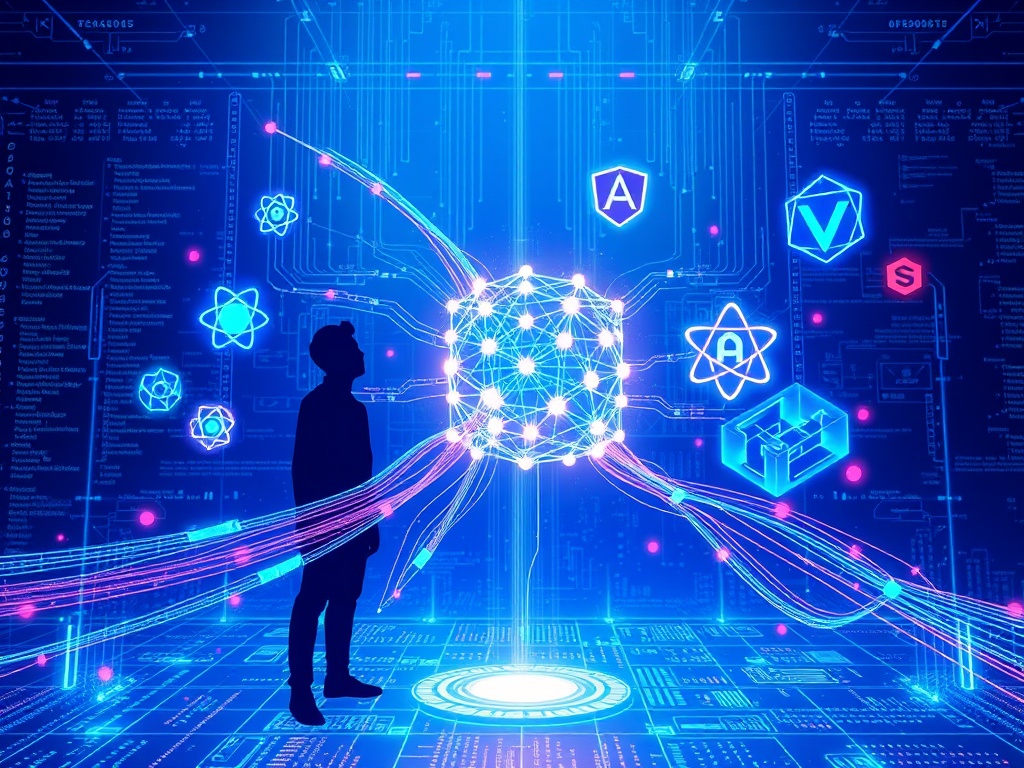
As we embrace AI in web dev ecosystems, groundbreaking multi-agent systems and innovative AI code generation tools propel the industry forward. This article delves into how these technologies redefine modern web development, from natural language programming to streamlined workflows.
The Advent of AI Code Generation in Web Development
The Advent of AI Code Generation in Web Development:
The landscape of web development is undergoing a seismic shift with the introduction of AI code generation tools, placing AI-first web development at the forefront of creating innovative and efficient web solutions. These tools are redefining the way developers approach coding from the ground up, offering unprecedented automation in tasks such as scaffolding, debugging, and integration with integrated development environments (IDEs) and browser environments. This chapter delves into the current state of AI code generation tools, their pivotal role in automating web development processes, and the notable impact they have on programming languages like JavaScript, as well as frameworks such as React, Vue, Angular, and Svelte in the context of full-stack application development.
AI code generation tools leverage advanced algorithms and multi-agent AI systems in web development to interpret natural language inputs from developers, converting them into functional code snippets. This approach not only accelerates the development process but also considerably reduces the potential for human error. For instance, by describing desired features in straightforward English, developers can now generate code for major frontend frameworks, automate repetitive coding tasks, swiftly perform error corrections, and set up comprehensive testing environments without deep-diving into manual coding.
Furthermore, the integration of AI code generation tools with popular IDEs has streamlined the development workflow, allowing for real-time syntax and error checking, intelligent suggestions for code improvement, and seamless compatibility with browser environments for immediate feedback on changes made. This seamless integration is paramount for frontend development, particularly with frameworks like React, Vue, Angular, and the newly supported Next.js, Astro, and SvelteKit, enhancing productivity and enabling developers to focus more on design and user experience aspects.
The adoption of AI code generation tools also bears significance in full-stack development. By reducing the manual coding necessary for backend operations and database management, these tools enable a more cohesive development process. They support a range of backend frameworks and languages, ensuring that both the client and server sides of web applications can be developed with AI assistance, thereby ensuring a more integrated and efficient development lifecycle.
However, this shift towards minimal manual coding is not without its challenges. The reliance on AI for code generation necessitates a deeper understanding of how AI algorithms interpret instructions, requiring developers to adapt their coding practices to effectively communicate with these tools. Additionally, while AI can significantly reduce debugging time through intelligent error detection and correction, developers must still possess a strong grasp of the underlying principles to ensure the reliability and security of the generated code. The need for human oversight in architecture decisions, security practices, and sustainability considerations further underscores the importance of a balanced approach between AI assistance and human expertise in web development.
The benefits of AI code generation in web development are undeniable, offering unparalleled efficiency and the potential for more personalized user experiences. Yet, as these tools become increasingly integral to the web development process, the role of the developer is also evolving, marking a transition towards guiding AI through high-level instructions rather than engaging in manual coding. This evolution not only streamlines workflow but also opens up new opportunities for creativity and innovation in web development. As we move forward, the key to harnessing the full potential of AI in web development will lie in the successful integration of AI tools with human insight and creativity, ensuring that web applications remain not only efficient and effective but also secure, accessible, and sustainable.
Navigating AI-First Development Methodology
The evolution of web development methodologies has been significantly influenced by the advent of AI-first approaches, marking a paradigm shift from traditional coding practices to a more interactive, AI-driven workflow. This change heralds a new age in software development, deeply rooted in the principles of AI code generation tools, AI-first web development, and the integration of multi-agent AI systems in web development. The transformation is profound, necessitating a reevaluation of the developer’s role from coder to conductor, orchestrating the symphony of AI agents to achieve desired outcomes.
In this AI-first framework, the developer’s primary task evolves from writing line-by-line code to providing high-level, natural language instructions that AI tools translate into functional code. This process is compatible with major frontend frameworks like React, Vue, Angular, and newly supporting frameworks like Next.js and SvelteKit. Far beyond simple code generation, these AI tools offer capabilities including intelligent debugging, error correction, test setups, and performance optimization, all refined through the latest advancements in AI technology.
This methodology requires developers to harness a new skill set focused on strategic code review, requirement specification, and pattern recognition. Developers must become adept at articulating project requirements in detail sufficient for AI to understand and execute, necessitating a deep understanding of project goals, user needs, and potential pitfalls. This skill set transcends traditional coding, embedding developers deeper into the conceptual and planning phases of projects.
Moreover, with AI handling the generation of code, developers can direct their attention towards more complex and creative tasks. This includes ensuring that AI-generated codes meet best practices for security, accessibility, and sustainability—an ever-important consideration given AI’s appetite for computational resources. In this environment, the capacity for critical evaluation and the application of human judgment becomes paramount. Developers must navigate the balance between leveraging AI’s capabilities for efficiency and innovation while mitigating potential risks associated with overreliance on automated systems.
Pattern recognition emerges as a crucial capability in this AI-first environment. Developers must fine-tune their ability to identify when AI-generated components can be reused or adapted for different segments of a project, enhancing productivity and consistency across web applications. Additionally, this skill facilitates the recognition of common pitfalls or bugs within AI-generated code, allowing for swift corrections and improvements.
The integration of multi-agent AI systems further enriches this landscape, introducing the concept of distributed tasks across specialized AIs. This multi-agent approach not only increases efficiency and scalability but also fosters a more dynamic and responsive development environment. Developers navigating this AI-first approach must therefore cultivate an understanding of how these systems interact, integrating them seamlessly into the development process. This requires an enhanced awareness of the capabilities of different AI agents and the strategic deployment of these resources to achieve the best outcomes.
Embracing AI-first web development, therefore, signifies a shift towards a more collaborative and iterative approach to software creation. Developers become the architects of a process that integrates human insight with AI efficiency, a synergy that promises to redefine the landscapes of web development. As we progress further into this new era, the focus remains on harnessing the full potential of AI code generation and multi-agent systems, ensuring that web development continues to advance in both innovation and inclusivity.
Harnessing Multi-Agent AI Systems for Web Development
Building on the transformative approach of AI-first web development discussed previously, harnessing multi-agent AI systems presents a novel paradigm in web development that significantly enhances efficiency, scalability, and resilience. Multi-agent AI systems work by distributing web development tasks across multiple specialized AI agents, each adept at handling specific aspects of the development process. This strategy not only accelerates development cycles but also improves the quality and reliability of web applications.
One of the key benefits of multi-agent AI systems in web development is their capacity to optimize efficiency. By dividing the workload among specialized agents, these systems can tackle multiple development tasks simultaneously, from code generation to debugging and performance optimization. This concurrent processing translates into faster development cycles, enabling developers to produce robust web applications in shorter timelines. For instance, while one AI agent generates functional components compatible with frameworks like React or Vue, another could be optimizing the application’s load time and performance, all within the same development phase.
Scalability is another significant advantage of multi-agent systems. As web projects grow in complexity and size, these systems can dynamically allocate more resources and specialized agents to maintain development speed and quality. Whether the project requires integrating advanced features like natural language chatbots or ensuring compatibility across different frameworks such as Next.js and SvelteKit, multi-agent AI systems can scale their capabilities to meet evolving demands without compromising on efficiency.
Resilience in web development is bolstered through the distributed nature of multi-agent AI systems. By relying on multiple agents, the system mitigates the risks associated with single points of failure. This distributed approach ensures that if one agent encounters an issue or fails, others can seamlessly take over or assist in resolving the problem, thereby maintaining the development momentum and safeguarding against delays.
Frameworks and architectures such as CrewAI and LangGraph are at the forefront of enabling these multi-agent systems in web development. CrewAI, for example, focuses on distributing tasks across AI agents based on their expertise, such as UI design, backend logic, or database management. LangGraph, on the other hand, excels in facilitating communication among these agents, allowing them to collaborate and share insights more effectively. This ensures that the output from one agent can seamlessly integrate with the work of another, enhancing the overall coherence and functionality of the final application.
The adoption of multi-agent AI systems in web development is driven by the need for more holistic and integrated approaches to handling complex projects. These systems showcase a departure from linear development processes to more dynamic, agile, and collaborative models. They not only accelerate the development process but also enhance the adaptability of web applications to changing requirements and technologies.
Despite the automation and advanced capabilities offered by multi-agent AI systems, the role of human developers remains crucial, particularly in overseeing the orchestration of tasks, ensuring alignment with project goals, and addressing areas like security, accessibility, and ethical considerations. The collaboration between human expertise and AI efficiencies epitomizes the evolving landscape of web development, where the integration of technology and human insight leads to innovative solutions and exceptional user experiences.
As we move forward to explore the implications of AI-first and multi-agent approaches on project management and team collaboration, it becomes evident that these technologies not only redefine individual roles but also reshape team dynamics and methodologies. Integrating these advanced AI capabilities demands new strategies for collaboration, task allocation, and managing interdependencies, heralding a new era in agile web development.
Implications for Project Management and Team Collaboration
The advent of AI-first web development and the integration of multi-agent AI systems present transformative implications for project management and team collaboration within the web development domain. These technological advancements are reshaping the landscape of how teams interact, distribute tasks, and manage the complex interdependencies inherent in contemporary web development projects. In particular, the application of AI code generation tools and AI-first web development methodologies necessitates a reevaluation of traditional agile methodologies and resource planning strategies to capitalize on the efficiencies and opportunities these technologies afford.
AI-first web development, where natural language can be used to describe desired features resulting in the AI producing corresponding code, radically alters the division of labor within web development teams. Tasks that were once the domain of front-end developers, such as generating code snippets, error correction, and performance tuning, can now be handled more efficiently by AI. This shift not only increases productivity but also frees up human developers to focus on more complex, creative tasks that require nuanced understanding and judgment such as architecture decisions and ensuring the accessibility and sustainability of web projects.
Similarly, the integration of multi-agent AI systems into web development workflows introduces a more holistic approach to task orchestration. These systems, which distribute tasks across multiple specialized AIs, necessitate a new framework for team collaboration. For instance, integrated dashboards can provide a unified view of development progress, consolidating inputs from different AI agents and human developers. This collaborative environment enhances communication and helps in managing the interdependencies between different components of the project, thereby streamlining the development process.
Agile methodologies, with their emphasis on adaptability and iterative development, are particularly well-suited to integrate the flexibility and speed of AI-first and multi-agent systems. However, agile practices may need to evolve to incorporate these technologies more effectively. Sprint planning sessions, for example, could be adapted to account for tasks performed by AI, adjusting timelines and task allocations to reflect the contributions of AI systems. Similarly, daily stand-ups could include updates on the progress of AI tasks, ensuring that human developers are informed and can adjust their work accordingly.
Resource planning also undergoes significant changes in this AI-driven context. With AI handling a portion of the coding tasks, project managers must reassess timelines and resource allocations. This not only includes the human resources but also the computational resources required to run these AI systems efficiently. Teams will need to become proficient in managing these AI resources, including understanding their limitations and costs, to ensure projects are completed within budget and on time.
Despite the efficiency gains offered by AI-first web development and multi-agent systems, challenges remain. Effective interdependency management in this context requires a deep understanding of both the capabilities and limitations of AI tools. Teams must navigate the balance between leveraging AI for speed and efficiency while ensuring that the final product meets the high standards expected by clients and users. Furthermore, as these AI systems become more integral to the web development process, the need for ongoing training and skill development among human team members becomes clearer. This ensures that teams can continue to collaborate effectively with their AI counterparts and address emerging challenges as the technology evolves.
In conclusion, the integration of AI code generation tools, AI-first web development methodologies, and multi-agent AI systems into web development workflows presents both opportunities and challenges for project management and team collaboration. By reevaluating traditional agile methodologies and resource planning strategies, teams can harness these technologies to enhance productivity, creativity, and efficiency, paving the way for the next generation of web development practices.
Preparing for the AI-Dominated Future of Web Development
As we pivot towards an AI-dominated future in web development, the landscape is poised for unprecedented transformation. The integration of AI code generation tools and multi-agent AI systems in web development has not only streamlined the coding process but also redefined the paradigms of web creation and maintenance. With AI-first web development ascending to the forefront, it is imperative for developers and organizations to remain agile and informed, ready to harness the full spectrum of AI’s potential while preserving the essence of human-centric design.
The trajectory of AI integration in web development is advancing at a breathtaking pace. We are witnessing AI’s capability to adapt and evolve, catering to an extensive array of frameworks such as React, Vue, Angular, and Svelte, with newer additions like Next.js, Astro, and SvelteKit marking just the beginning of this expansive journey. The emergence of intelligent debugging, real-time issue detection, accessibility audits, and dynamic UI adaptation indicates a move towards more sophisticated, efficient, and user-centric web development practices. Furthermore, the rise of natural language programming is simplifying the development process, making it more accessible and streamlining workflow efficiencies.
To stay competitive in this AI-enhanced landscape, developers and organizations must focus on continuous learning and adaptation. It is essential to familiarize oneself with the latest AI tools and frameworks, ensuring skills and projects remain relevant and innovative. Embracing an AI-first approach means not only leveraging these tools for code generation and debugging but also understanding the nuances of AI integration, from data handling to ethical considerations. Investing in training and resources to master these technologies will be pivotal in navigating the future of web development.
However, amid this rush towards automation and precision, maintaining a human-centric approach is paramount. The essence of design and the user experience must not be overshadowed by the efficiency and capabilities of AI. Developers should strive to integrate AI tools in a manner that enhances creativity and innovation, rather than diminishing it. This involves leveraging AI for the heavy lifting and computational aspects of development, while dedicating human creativity to areas like UX/UI design, content creation, and strategic planning. Incorporating feedback loops where AI-generated outcomes are reviewed and refined by human developers can ensure that the final product resonates with users on a personal and emotional level.
Incorporating AI into accessibility and sustainability practices is another area where human oversight is crucial. While AI can audit and suggest improvements, the final decision-making should consider ethical implications and long-term impacts. Organizations must adopt frameworks and best practices that ensure AI is used responsibly, promoting accessibility and minimizing carbon footprints to contribute to a more inclusive and sustainable digital future.
Finally, fostering a culture of collaboration between AI and human developers will be key to unlocking the full potential of AI-first web development. As AI takes on more complex tasks, the role of developers will evolve, emphasizing strategic oversight, creative input, and ethical considerations. By maintaining a balance between leveraging AI for efficiency and innovation and upholding the principles of human-centric design, the web development community can navigate the challenges and opportunities of this new era with confidence and creativity.
In summary, the future of web development is not just about adopting AI tools but about integrating them in a way that enhances human creativity, fosters innovation, and maintains a focus on user experience and ethical practices. As we step into this promising future, the synergy between AI capabilities and human ingenuity will pave the way for more dynamic, responsive, and meaningful web experiences.
Conclusions
The ascent of AI first approaches and multi-agent systems in web development is not just an evolution; it’s a revolution. These technologies enhance productivity and user experience but call for developers to adapt to new roles. Striking a balance between AI’s prowess and human insight will be crucial for sustainable advancement.