Level Up Your LLMs: Advanced RAG Techniques for Context-Aware AI
Large Language Models (LLMs) are revolutionizing how we interact with information, powering everything from chatbots to content creation tools. But even the most sophisticated LLMs have limitations, particularly when it comes to accessing and processing vast amounts of real-world knowledge. Enter Retrieval-Augmented Generation (RAG), a technique that supercharges LLMs by equipping them with the ability to retrieve relevant information from external sources before generating a response. This combination unlocks the potential for more informed, accurate, and context-aware AI.
However, basic RAG implementations often fall short. They can struggle with complex queries, fail to capture nuanced relationships between data points, or produce outputs that lack the depth and relevance required for demanding applications. This is where advanced RAG techniques come into play.
This post explores advanced RAG techniques that not only elevate LLMs but also enhance context awareness, relevance, and accuracy, making them indispensable in diverse AI applications. We’ll dive into the core principles, explore specific techniques, and discuss their real-world impact.
Understanding Advanced RAG Techniques
Advanced RAG techniques represent a significant leap beyond basic RAG frameworks. While traditional RAG focuses primarily on retrieving relevant documents and feeding them into the LLM prompt, advanced RAG incorporates strategies to refine the retrieval process, enhance the context provided to the LLM, and optimize the generation of the final output. The overarching purpose is to create AI systems that are more knowledgeable, adaptable, and reliable.
These methods improve upon basic RAG by addressing limitations such as:
- Difficulty handling complex or multi-faceted queries.
- Inability to capture semantic relationships between data points.
- Generation of generic or superficial responses.
- Poor performance with noisy or incomplete data.
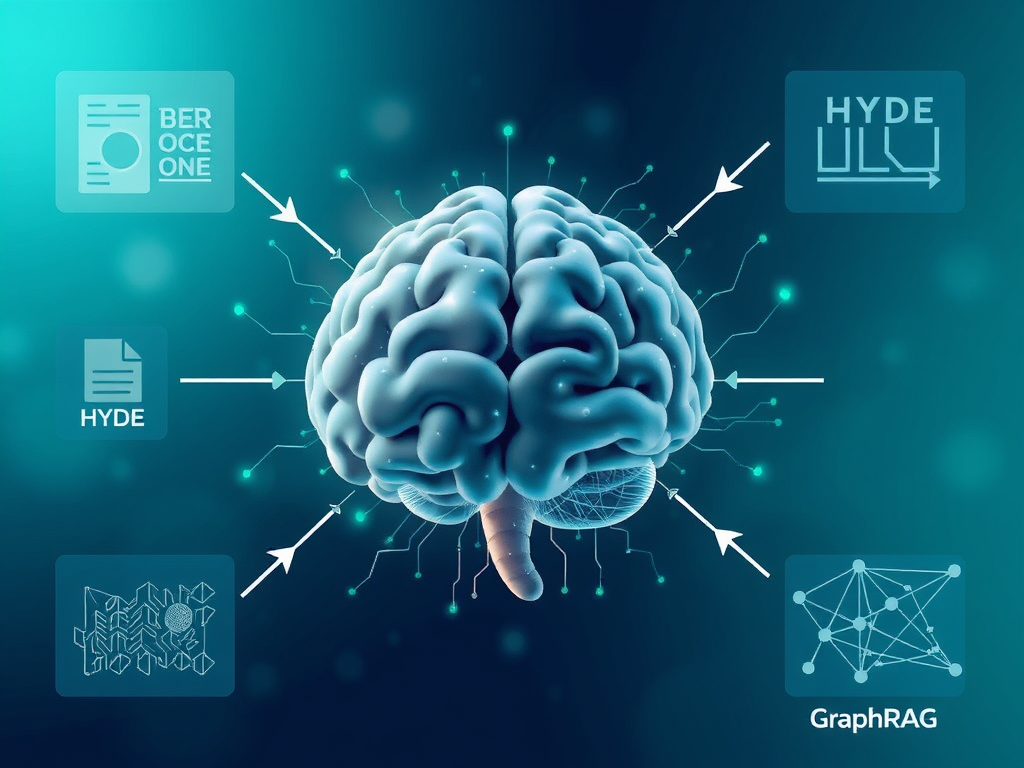
Several advanced techniques have emerged to tackle these challenges. We will explore the following key methods:
- Hybrid Search: Combining lexical and semantic search approaches for robust retrieval.
- HyDE (Hypothetical Document Embeddings): Generating hypothetical documents to improve query-document similarity matching.
- RAT (Retrieval Augmented Thoughts): Integrating Chain-of-Thought prompting with retrieval to enhance reasoning.
- GraphRAG: Utilizing knowledge graphs to capture relationships between data points and improve retrieval accuracy.
- Advanced Chunking Techniques: Optimizing the size and content of text chunks for better information retrieval.
In-Depth Analysis of Key Advanced RAG Techniques
A. Hybrid Search
Hybrid search combines the strengths of both lexical and semantic search methods to achieve more comprehensive and accurate retrieval. Lexical search, like BM25, relies on keyword matching and term frequency to identify relevant documents. Semantic search, on the other hand, uses vector embeddings to capture the meaning and context of queries and documents, allowing for retrieval based on semantic similarity rather than exact keyword matches.
The integration of lexical and semantic search offers several advantages:
- Improved Recall: Captures a broader range of relevant documents by considering both keyword matches and semantic similarity.
- Enhanced Precision: Reduces irrelevant results by leveraging the strengths of both approaches.
- Robustness: Performs well even when queries contain typos, synonyms, or ambiguous language.
Example: Imagine a user searching for “best camera for wildlife photography.” A lexical search might prioritize documents containing those exact keywords. A semantic search might identify articles discussing cameras with features suitable for wildlife photography, even if the exact phrase isn’t present. Hybrid search combines both approaches, ensuring that the results include both keyword-rich articles and semantically relevant content, leading to a more complete and useful set of results.
Step-by-step Reasoning:
- **User Input:** The user submits the query: “best camera for wildlife photography.”
- **Lexical Search (e.g., BM25):** The system searches for documents containing the keywords “best,” “camera,” “wildlife,” and “photography.” It ranks documents based on term frequency and inverse document frequency.
- **Semantic Search (e.g., Sentence Transformers):** The system encodes the query and all documents into vector embeddings using a model like Sentence Transformers. It then calculates the cosine similarity between the query embedding and the document embeddings, ranking documents based on semantic similarity.
- **Fusion:** The results from the lexical and semantic searches are combined using a fusion technique (e.g., reciprocal rank fusion). This combines the rankings from both approaches, giving higher weight to documents that rank well in both.
- **Output:** The system returns a ranked list of documents, with the most relevant results appearing at the top. This list includes documents that are both keyword-rich and semantically similar to the query.
B. HyDE (Hypothetical Document Embeddings)
HyDE is an innovative RAG technique that enhances retrieval by generating a hypothetical document based on the user’s query. Instead of directly comparing the query to existing documents, HyDE first uses an LLM to imagine what a relevant document might look like. This hypothetical document is then used to find similar real documents in the knowledge base.
The concept behind HyDE is that the hypothetical document captures the underlying meaning and context of the query, allowing for more accurate similarity matching. It’s like asking an LLM to “explain” the query in the form of a document, and then using that explanation to find relevant information.
Example: A user asks, “What are the health benefits of turmeric?” Instead of directly searching for documents containing those keywords, HyDE first uses an LLM to generate a hypothetical article summarizing the health benefits of turmeric. This hypothetical article might mention specific compounds in turmeric, such as curcumin, and their effects on inflammation, antioxidant activity, and brain health. The system then searches for real articles that are similar to this hypothetical article, leading to more targeted and relevant results.
Step-by-step Reasoning:
- **User Input:** The user submits the query: “What are the health benefits of turmeric?”
- **Hypothetical Document Generation:** The query is fed to an LLM (e.g., GPT-3.5). The LLM generates a hypothetical document that answers the query, describing the potential health benefits of turmeric. This document might mention curcumin, anti-inflammatory properties, antioxidant effects, etc.
- **Embedding Generation:** The hypothetical document is converted into a vector embedding using a sentence embedding model.
- **Similarity Search:** The system performs a similarity search between the embedding of the hypothetical document and the embeddings of the documents in the knowledge base.
- **Output:** The system returns the documents from the knowledge base that are most similar to the hypothetical document. These documents are likely to contain information about the health benefits of turmeric.
C. RAT (Retrieval Augmented Thoughts)
RAT takes RAG a step further by integrating Chain-of-Thought (CoT) prompting. CoT prompting encourages the LLM to break down a complex problem into a series of smaller, more manageable steps, explaining its reasoning process along the way. By combining CoT with retrieval, RAT allows the LLM to not only access relevant information but also to reason about that information in a more structured and coherent manner.
This approach is particularly effective for tasks that require reasoning, inference, or problem-solving. The retrieval component provides the LLM with the necessary knowledge, while the CoT component guides the LLM through the reasoning process.
Example: A user asks, “What is the capital of the country with the largest population in Africa?” A standard RAG system might retrieve documents listing African countries and their populations. However, RAT would first encourage the LLM to break down the problem: (1) Identify the countries in Africa. (2) Determine the population of each country. (3) Find the country with the largest population. (4) Identify the capital of that country. By guiding the LLM through this reasoning process, RAT ensures that the answer is accurate and well-supported.
Step-by-step Reasoning:
- **User Input:** The user submits the query: “What is the capital of the country with the largest population in Africa?”
- **Chain-of-Thought Prompting:** The system prompts the LLM to use a Chain-of-Thought approach: \”Let’s think step by step. First, we need to identify the countries in Africa. Then, we need to find the population of each country. Next, we need to determine which country has the largest population. Finally, we need to identify the capital of that country.\”
- **Retrieval (Multiple Steps):** For each step in the CoT process, the system retrieves relevant information from the knowledge base. For example, it might retrieve a list of African countries and their populations from Wikipedia.
- **Reasoning and Generation:** The LLM uses the retrieved information and the CoT steps to reason about the answer. It identifies Nigeria as the country with the largest population in Africa. It then retrieves the capital of Nigeria, which is Abuja.
- **Output:** The LLM generates the final answer: “The capital of the country with the largest population in Africa is Abuja.”
D. GraphRAG
GraphRAG leverages knowledge graphs to enhance retrieval accuracy. Knowledge graphs represent information as a network of entities (nodes) and relationships (edges). This allows the system to capture complex relationships between data points and to retrieve information based on these relationships.
Instead of treating documents as isolated units, GraphRAG treats them as part of a larger network of knowledge. This allows the system to understand the context of the information and to retrieve more relevant results.
Example: A user asks, “What are the side effects of the drug that inhibits the EGFR protein?” A traditional RAG system might retrieve documents mentioning the drug and EGFR, but it might not capture the relationship between the drug, EGFR, and specific side effects. GraphRAG, however, would represent this information in a knowledge graph, with nodes for the drug, EGFR, and various side effects, and edges representing the relationships between them. This allows the system to retrieve documents that specifically discuss the side effects of the drug in relation to EGFR inhibition.
Step-by-step Reasoning:
- **User Input:** The user submits the query: “What are the side effects of the drug that inhibits the EGFR protein?”
- **Graph Traversal:** The system uses the query to traverse the knowledge graph. It starts by identifying the nodes corresponding to “drug” and “EGFR protein.” It then follows the edges connecting these nodes to other nodes representing relationships such as “inhibits” and “side effects.”
- **Information Retrieval:** The system retrieves information from the nodes and edges that are relevant to the query. This might include the names of specific drugs that inhibit EGFR, the mechanisms of action of these drugs, and the known side effects associated with them.
- **Output:** The system generates a response that summarizes the information retrieved from the knowledge graph. This response might include a list of drugs that inhibit EGFR and a description of their common side effects.
E. Advanced Chunking Techniques
Chunking refers to the process of dividing large documents into smaller, more manageable segments. The way you break down text into chunks significantly impacts retrieval performance. Advanced chunking techniques go beyond simple fixed-size chunking and aim to create chunks that are semantically coherent and contextually relevant.
Several advanced chunking methods exist, including:
- Semantic Chunking: Dividing documents based on semantic boundaries, such as paragraphs or sections.
- Context-Aware Chunking: Considering the surrounding context when creating chunks, ensuring that related information is grouped together.
- Recursive Chunking: Using a hierarchical approach to chunking, creating both large and small chunks to capture different levels of granularity.
Example: Instead of simply dividing a document into fixed-size chunks of 500 words, a semantic chunking approach might break the document into sections based on headings and subheadings. This ensures that each chunk represents a distinct topic or subtopic, improving retrieval relevance. A context-aware approach might further refine these chunks by merging or splitting them to ensure that related information is grouped together, even if it spans multiple sections.
Step-by-step Reasoning:
- **Input Document:** The system receives a large document containing multiple sections and paragraphs.
- **Semantic Analysis:** The system analyzes the document to identify semantic boundaries, such as headings, subheadings, paragraph breaks, and sentence boundaries.
- **Chunk Creation:** The system creates chunks based on the semantic boundaries. For example, it might create a chunk for each section, each paragraph, or each sentence.
- **Contextual Refinement (Optional):** The system analyzes the context of each chunk to determine if it should be merged or split with neighboring chunks. This ensures that related information is grouped together, even if it spans multiple semantic boundaries.
- **Output:** The system outputs a set of semantically coherent and contextually relevant chunks.
Advantages of Implementing Advanced RAG Techniques
Implementing advanced RAG techniques offers numerous benefits for LLM applications:
- Enhanced Contextual Understanding: Advanced techniques enable LLMs to better understand complex queries and capture nuanced relationships between data points, leading to more accurate and relevant results. This is particularly crucial for tasks that require reasoning, inference, or problem-solving.
- Increased Accuracy: By leveraging more sophisticated retrieval and reasoning methods, advanced RAG techniques help to ensure that LLMs provide users with more reliable and accurate information. This is essential for applications where accuracy is paramount, such as in healthcare or finance.
- Customization: Advanced RAG techniques can be tailored to specific industry needs and applications. This allows organizations to optimize the performance of their LLMs for their specific use cases, maximizing the value of their AI investments. For example, a healthcare organization might use a knowledge graph to capture relationships between diseases, symptoms, and treatments, while a finance company might use hybrid search to retrieve information about market trends and investment opportunities.
Real-World Applications of Advanced RAG Techniques
A. Chatbots and Virtual Assistants
Advanced RAG techniques significantly improve the performance of chatbots and virtual assistants by enabling them to provide more accurate, relevant, and context-aware responses. By leveraging hybrid search, HyDE, and GraphRAG, chatbots can better understand user queries, retrieve relevant information from diverse sources, and provide more comprehensive and personalized assistance.
B. Content Generation
Advanced RAG techniques enhance the quality and relevance of generated content by providing LLMs with access to a wider range of information and enabling them to reason about that information in a more structured manner. By using RAT and advanced chunking techniques, content generation tools can create articles, summaries, and other types of content that are more informative, engaging, and tailored to the specific needs of the user.
C. Knowledge Management
Advanced RAG techniques improve information retrieval and systematization within organizations by enabling employees to quickly and easily access the information they need. By leveraging hybrid search, HyDE, and GraphRAG, knowledge management systems can provide more accurate and relevant search results, helping employees to find the information they need to make better decisions and solve problems more effectively.
Challenges and Considerations in Implementing Advanced RAG
Implementing advanced RAG techniques can be challenging, requiring careful consideration of several factors:
- Optimizing Retrieval Efficiency: Balancing the need for accuracy with the need for speed is crucial. Advanced techniques can be computationally expensive, so it’s important to optimize the retrieval process to ensure that it remains efficient. Techniques like vector databases and caching can help to improve retrieval speed.
- Managing Data Quality: The quality of the data used for retrieval directly impacts the relevance and credibility of the results. It’s important to ensure that the data is accurate, complete, and up-to-date. Data cleaning and validation processes are essential for maintaining data quality.
- Complexity of Implementation and Maintenance: Implementing and maintaining advanced RAG systems can be complex, requiring expertise in LLMs, information retrieval, and data management. Organizations should consider the resources required to build and maintain these systems before embarking on an advanced RAG project. Frameworks like Haystack and Langchain can help simplify the implementation process.
Conclusion with Key Takeaways
Advanced RAG techniques represent a significant advancement in the field of AI, offering a powerful way to enhance the capabilities of LLMs and unlock new possibilities for context-aware applications. By leveraging hybrid search, HyDE, RAT, GraphRAG, and advanced chunking techniques, organizations can create AI systems that are more knowledgeable, adaptable, and reliable.
These methods hold immense potential for transforming a wide range of industries, from healthcare and finance to education and entertainment. As RAG research continues to evolve, we can expect to see even more innovative applications emerge, further blurring the lines between human and artificial intelligence.
The future of AI is context-aware, and advanced RAG techniques are paving the way.